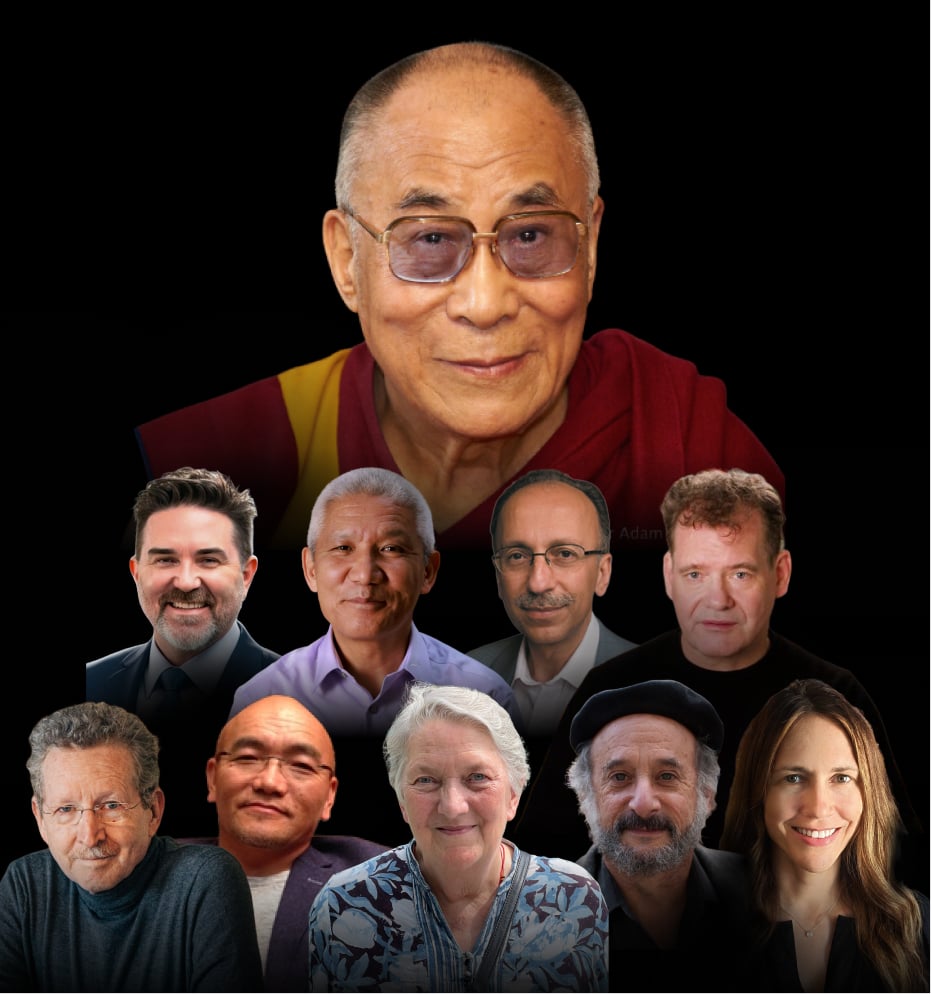
About this Course
Wisdom is honored to offer this online course to share and celebrate the liberating teachings of the Nalanda Tradition. We have created this course, based on the book series Science and Philosophy in the Indian Buddhist Classics, in support of His Holiness’s vision that the world should discover, and benefit from, the jewels of India’s Buddhist teachings, embodied by the seventeen Nalanda masters—including figures such as Nāgārjuna, Śāntideva, and Dharmakīrti.
Lessons
Lesson 1: The Power of Reasoning
Available on: 19-Dec-2025
His Holiness the Dalai Lama opens the series in conversation with Wisdom CEO/Publisher Daniel Aitken, PhD, exploring the Nalanda Tradition’s devotion to reasoning. He discusses why Buddhist inquiry has always relied on logic and debate rather than faith, and how this heritage naturally complements modern science.
His Holiness the Dalai Lama opens the series in conversation with Wisdom CEO/Publisher Daniel Aitken, PhD, exploring the Nalanda Tradition’s devotion to reasoning. He discusses why Buddhist inquiry has always relied on logic and debate rather than faith, and how this heritage naturally complements modern science.
Lesson 2: The Buddhist Science of the Physical World
Available on: 26-Dec-2025
In this lesson, series editor Geshe Thupten Jinpa, PhD, guides you into the first volume of the Science and Philosophy series, The Physical World, revealing how Buddhism developed its own science of the physical world—mapping atoms, elements, time, and the cosmos to uncover the deep law of cause and effect that still shapes our lives today.
In this lesson, series editor Geshe Thupten Jinpa, PhD, guides you into the first volume of the Science and Philosophy series, The Physical World, revealing how Buddhism developed its own science of the physical world—mapping atoms, elements, time, and the cosmos to uncover the deep law of cause and effect that still shapes our lives today.
Lesson 3: The Illusion of a Solid World
Available on: 02-Jan-2026
Michel Bitbol, PhD, a physicist and philosopher of science, enhances our understanding of volume 1, The Physical World. He explores how Greek and Indo-Buddhist sciences, which shared common origins, temporarily diverged due to the Western hyper-focus on detached objectivity, and now reconverge in modern physics and phenomenology—both of which treat knowledge as relational, exposing the emptiness of fixed viewpoints.
Michel Bitbol, PhD, a physicist and philosopher of science, enhances our understanding of volume 1, The Physical World. He explores how Greek and Indo-Buddhist sciences, which shared common origins, temporarily diverged due to the Western hyper-focus on detached objectivity, and now reconverge in modern physics and phenomenology—both of which treat knowledge as relational, exposing the emptiness of fixed viewpoints.
Lesson 4: Lessons from The Mind
Available on: 09-Jan-2026
John Dunne, PhD, a scholar of Buddhist philosophy and contemplative science, guides us into Volume 2, The Mind. He introduces a Buddhist account of a “scientific” understanding of mind—one that explains experience without a fixed self, seeing the mind instead as a dynamic system of interacting processes. Drawing on analyses of attention, emotion, and knowledge, Dunne shows how these illuminate the Buddhist aims of reducing suffering and cultivating genuine flourishing. He also examines meditation practices that develop meta-awareness, revealing the mind’s capacity for wisdom and compassion.
John Dunne, PhD, a scholar of Buddhist philosophy and contemplative science, guides us into Volume 2, The Mind. He introduces a Buddhist account of a “scientific” understanding of mind—one that explains experience without a fixed self, seeing the mind instead as a dynamic system of interacting processes. Drawing on analyses of attention, emotion, and knowledge, Dunne shows how these illuminate the Buddhist aims of reducing suffering and cultivating genuine flourishing. He also examines meditation practices that develop meta-awareness, revealing the mind’s capacity for wisdom and compassion.
Lesson 5: Coming Soon
Available on: 16-Jan-2026
…
…
Lesson 6: The Nalanda Tradition
Available on: 23-Jan-2026
We enter volume 3 in the series, Philosophical Schools, with Donald Lopez, PhD, in a rich exploration of the Nalanda Tradition—the ancient Indian university system that shaped Tibetan Buddhism. Dr. Lopez explains why the Dalai Lama chose this term, recounts Nalanda’s history, and introduces the seventeen great masters celebrated in His Holiness’s poem. A captivating overview of how India’s culture of reason, debate, and insight continues to animate Buddhist learning today.
We enter volume 3 in the series, Philosophical Schools, with Donald Lopez, PhD, in a rich exploration of the Nalanda Tradition—the ancient Indian university system that shaped Tibetan Buddhism. Dr. Lopez explains why the Dalai Lama chose this term, recounts Nalanda’s history, and introduces the seventeen great masters celebrated in His Holiness’s poem. A captivating overview of how India’s culture of reason, debate, and insight continues to animate Buddhist learning today.
Lesson 7: Buddhist Siddhāntas (Schools) as Living Phenomenology
Available on: 30-Jan-2026
Sonam Thakchoe, PhD, enriches our exploration of volume 3 as he reimagines the study of Buddhist philosophy as a journey of lived experience rather than a set of abstract doctrines. Instead of treating the philosophical schools as separate systems, he presents them as progressive stages in a practitioner’s unfolding awareness—each emerging naturally from the insights of the previous. Through this phenomenological lens, Buddhist thought becomes a map of inner transformation, revealing how philosophy provides a path of realization.
Sonam Thakchoe, PhD, enriches our exploration of volume 3 as he reimagines the study of Buddhist philosophy as a journey of lived experience rather than a set of abstract doctrines. Instead of treating the philosophical schools as separate systems, he presents them as progressive stages in a practitioner’s unfolding awareness—each emerging naturally from the insights of the previous. Through this phenomenological lens, Buddhist thought becomes a map of inner transformation, revealing how philosophy provides a path of realization.
Lesson 8: Using Philosophical Investigation to Uproot Suffering
Available on: 06-Feb-2026
Bringing us into volume 4 of the series, Philosophical Topics, Tenzin Dechen Rochard, PhD, guides us through the major themes of Buddhist philosophy, from the two truths and selflessness to the rationale of emptiness and the nature of knowledge. Drawing on centuries of Indian and Tibetan insight, she shows how reasoning and meditation converge in the quest to see things as they truly are—transforming philosophy from an academic pursuit into a living path of understanding that leads to the removal of suffering.
Bringing us into volume 4 of the series, Philosophical Topics, Tenzin Dechen Rochard, PhD, guides us through the major themes of Buddhist philosophy, from the two truths and selflessness to the rationale of emptiness and the nature of knowledge. Drawing on centuries of Indian and Tibetan insight, she shows how reasoning and meditation converge in the quest to see things as they truly are—transforming philosophy from an academic pursuit into a living path of understanding that leads to the removal of suffering.
Lesson 9: Subject, Object, and the Expanse of Emptiness
Available on: 13-Feb-2026
Jay Garfield, PhD, brings together the Madhyamaka and Yogācāra traditions to reveal a complete vision of emptiness—seen from both the object and the mind that perceives it. Building on the Dalai Lama’s insights, he explains how the illusion of subject and object gives rise to suffering, and how understanding interdependence transforms the mind.
Jay Garfield, PhD, brings together the Madhyamaka and Yogācāra traditions to reveal a complete vision of emptiness—seen from both the object and the mind that perceives it. Building on the Dalai Lama’s insights, he explains how the illusion of subject and object gives rise to suffering, and how understanding interdependence transforms the mind.
Lesson 10: Reason and Compassion: The Heart of the Nalanda Tradition
Available on: 20-Feb-2026
To close our course, series editor Geshe Thupten Jinpa, PhD is joined by Allison Aitken, PhD, for a conversation on reason, compassion, and the living legacy of Nalanda. Together they examine the role of philosophical analysis within Buddhist thought and practice, and explore possibilities for fruitful dialogue between Buddhist philosophy and contemporary Western traditions. The lesson provides a profound reflection on how knowledge becomes wisdom—and how philosophy, when joined with compassion, offers a complete path for both personal and collective transformation.
To close our course, series editor Geshe Thupten Jinpa, PhD is joined by Allison Aitken, PhD, for a conversation on reason, compassion, and the living legacy of Nalanda. Together they examine the role of philosophical analysis within Buddhist thought and practice, and explore possibilities for fruitful dialogue between Buddhist philosophy and contemporary Western traditions. The lesson provides a profound reflection on how knowledge becomes wisdom—and how philosophy, when joined with compassion, offers a complete path for both personal and collective transformation.
About the Teacher