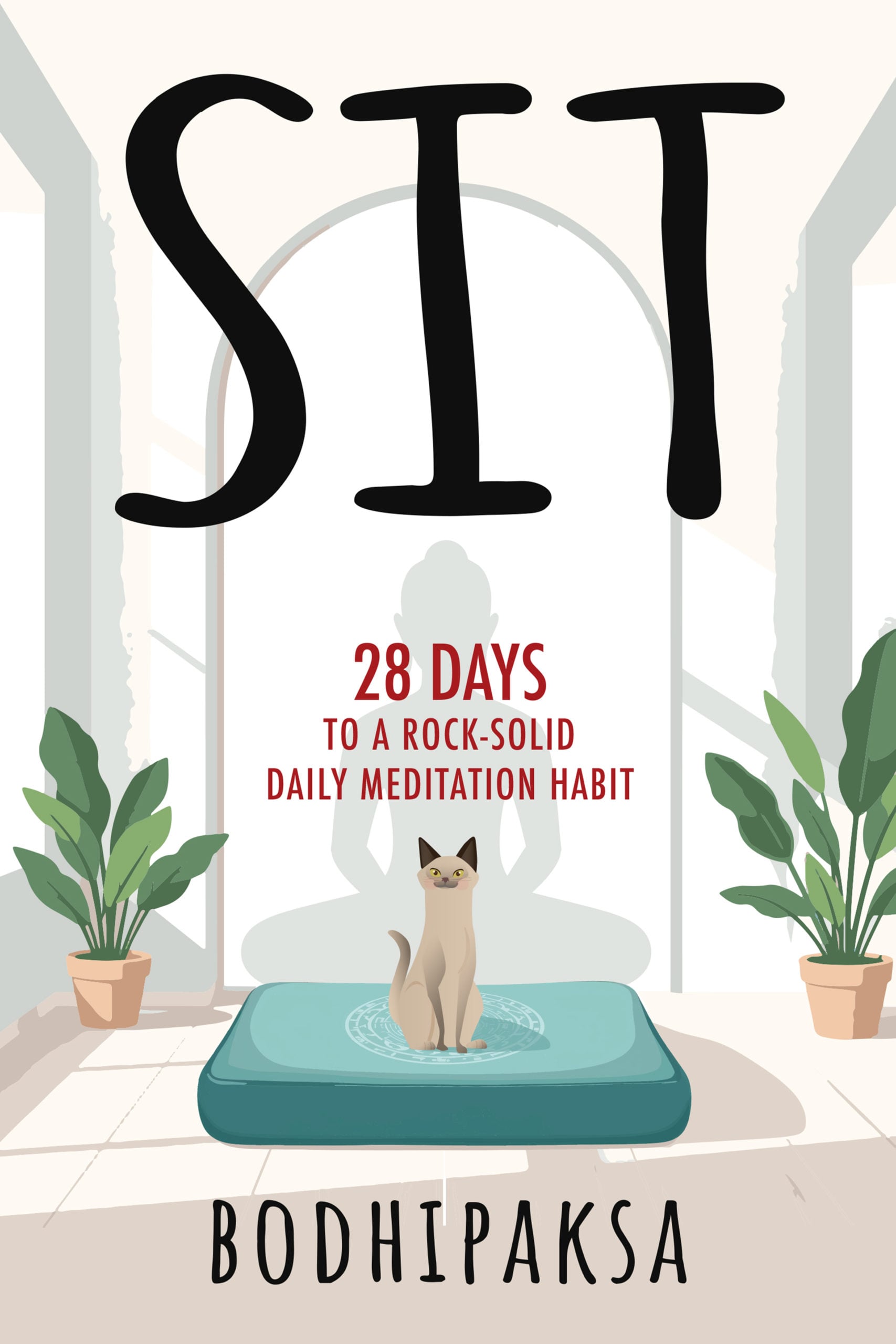
SIT
Twenty-Eight Days to a Rock-Solid Daily Meditation Habit
A popular Buddhist teacher guides you through strategies to build and maintain a rock-solid daily meditation practice—from setting reminders to dealing with setbacks to introducing the philosophical concepts underpinning Buddhist meditation—and everything in between.
It’s widely known that there are many benefits to meditation, particularly if undertaken regularly, but making it a daily habit can be a challenge for many people. Why? Because it takes more than willpower.
Here, longtime meditation teacher and Buddhist blogger Bodhipaksa presents a collection of strategies and tools to help build a rock-solid daily meditation practice into your life. The book is divided into twenty-eight chapters, one for each day.
Each chapter starts with a Practice Reminder, just a few words reminding readers of the importance of practicing meditation rather than merely reading about it. There’s also a link to a web page of guided meditations.
Following that is a Today section, a brief summary of the day’s reading.
Then there’s a Strategies section, which offers suggestions to help readers build the habit of meditating daily. Strategies can be as simple as setting reminders or using a meditation timer, or more involved tools such as changing any belief that you lack what it takes to meditate daily.
That’s followed by a Going Deeper section, with a deeper exploration of some of the Buddhist teachings underpinning our practice, often referring to the suttas, or scriptures, of early Buddhism.
Next is a Reflection section, which encourages readers to keep a journal to make the content of the Going Deeper section more experiential.
Each chapter ends with a Last Words section, quickly summarizing the Going Deeper section.
To help you get started, Bodhpaksa has recorded eighteen meditations for you to listen to and provided a 28-day calendar to help track your deepening meditation habit. Simply scan the QR code in the book for access.
About the Author

Bodhipaksa is a Buddhist teacher and author who is originally from Scotland but now lives in New Hampshire. He has practiced in the Triratna Buddhist Community since 1982, and became a member of the Triratna Buddhist Order in 1993. The author of several books, Bodhipaksa also runs Wildmind (http://www.wildmind.org), an online meditation center with a mission to spread compassion and mindfulness through the practice of Buddhist meditation. Most of his teaching is done through Wildmind. Bodhipaksa is the father of two adopted children, and counts his children among his spiritual teachers.
Book Information
- Paper Over Board
- 256 pages, 6 x 9 inches
- $19.95
- ISBN 9798890700087
- eBook
- 256 pages
- $14.99
- ISBN 9798890700179
Praise
"Sit offers more than tips for establishing a daily meditation practice. This book gently guides readers to understand and transform the subtle mental habits that may be limiting our potential and influencing the myriad choices we make every day of our lives. By taking these simple practice tips to heart, readers will develop effective life skills and break out of restrictive habit patterns wherever and however they may appear.” —Shaila Catherine, author of Beyond Distraction: Five Practical Ways to Focus the Mind
“Bodhipaksa provides us with wonderfully practical steps for developing the habit of meditation! He shares research-based methods for creating and sustaining healthy behaviors, and combines these with insights from the Buddha and later Buddhist teachers on meditation. There is now a very large body of research on the benefits of mindfulness and other meditation techniques. If you want to cultivate a regular meditation practice (or habituate to any other healthy behaviors), then I highly recommend this book!”—Lorne Ladner, PhD, psychologist and author of The Lost Art of Compassion
“Sit delivers a time-tested truth in clear, relatable language: consistency beats intensity every time. Bodhipaksa shows us that the real magic of meditation isn’t found in rare peak experiences, but in the steady rhythm of showing up daily. A little effort, repeated again and again, becomes a lifetime of practice.” —Miguel Chen, author of I Wanna Be Well: How a Punk Found Peace and You Can Too, and musician, Teenage Bottlerocket
“Bodhipaksa’s calling as a brilliant meditation coach is a gift to us all. I am glad to see him going both wide and deep with Sit—a clear, comprehensive, compassionate program combining wise strategies and practical tactics, timeless insight and personal reflection. Please enjoy these nourishing marvels of the dailiness of meditation. Up your game in this vital, evolutionary sport. Commit to Sit, and be happily transformed.”—Gary Gach, author of Pause . . . Breathe . . . Smile
Discover More

6 Myths We Live By
Buddhist wisdom for everyday problems rooted in Buddhist psychology and meditation, 6 Myths We Live By shows us how to uncover our misperceptions and leads us on a path to self-development.
The truth is you probably believe all sorts of myths, but you don’t even know it. To escape any hardship, any suffering or discomfort, we all believe myths about how the world works and how we live in that world. In 6 Myths We Live By, therapist and long-time Buddhist practitioner Karuna Cayton guides us through six common myths that may give us comfort, but actually only perpetuate our problems:
the myth of reality,
the myth of identity,
the myth of permanence,
the myth of randomness,
the myth of happiness, and
the myth of only living once.
Cayton takes us through each of these myths using real-world examples and draws upon Buddhist principles, psychology, and meditation practices to show how we can wake up to reality. By planting a seed of doubt about the beliefs that we’ve always thought were true, we can open our eyes and deepen our relationship with the way we see our life, our potential, and the nature of our struggles and achievements.
Severance
An ancient Buddhist guide to confronting difficult circumstances and letting go of clinging to the ego.
Severance, or Cho, is the Tibetan Buddhist practice of facing one’s fears. In three remarkable texts lucidly translated and introduced by Sarah Harding, the thirteenth-century Severance master Jamyang Gönpo shares advice that goes straight to the heart of both understanding and experiencing the practice. For hundreds of years, Severance has remained essentially an instruction on coping with stressful situations that provoke fear and, beyond that, a way to actively seek out such circumstances in order to test one’s realization of perfect wisdom.
The single overall directive of the first two texts in this volume—the Heart Essence of Profound Meaning root verses and their commentary, The Big General Guide to Severance—is to seek out and directly confront difficult circumstances. Here, these difficulties are often anxieties related to spirits in the dark of night in haunted places. This practice acts as a means to recognize emptiness—the lack of intrinsic existence of all phenomena—as well as a testing ground of one’s former realizations and studies of that emptiness from the Perfection of Wisdom. The texts are notable for their lack of instruction on ritualized Severance involving body sacrifice, which later works emphasize; in these texts, the heart of Severance is letting go of clinging to the self and reification of existence. And as Jamyang Gonpo was just a generation removed from Machik Labdron, the main progenitor of Severance, his methods seem to be closest to her actual teachings.
The third translation in this volume, The Seven-Day Severance Retreat Experiential Guide, is a very concise and precise instruction on putting the main intentions of the teachings into practice in the setting of a one-week retreat. The instructions are striking in that they contain no rituals, visualizations, deities, instruments, or liturgies. Jamyang Gönpo shows us how to turn our attention to the very mind of this person who is experiencing fear and the object of that fear—whether fear about demons or sickness or suffering—to see them for what they are. In doing so, we find that joys and sorrows, highs and lows, powers of gods and demons, and demonic obstacles are all mind made.
The Fundamental Practices
A wise and warm guide to the preliminary practices that lay the fundamental groundwork for traversing the path to buddhahood.
When we start on the transformational journey to enlightenment, we need a strong foundation in core Buddhist principles and practices to set us on the right track. The ngöndro, or preliminary practices, are that very foundation; they not only prepare us for advanced practice but serve us in all we do. In this guide to the common and uncommon preliminary practices, His Holiness the Forty-Second Sakya Trizin, Ratna Vajra Rinpoche, expertly gives us the grounded, practical, and illuminating teachings we need to set out on the path to buddhahood. Newcomers and seasoned practitioners alike will find practical guidance and profound wisdom to support them through their exploration of the preliminary practices.
The common preliminary practices are the four thoughts that turn the mind away from the suffering of samsara and toward the Dharma: remembering the shortcomings of samsara, remembering the preciousness of a human rebirth, remembering impermanence, and remembering the law of karma. These teachings are shared among traditions and will accompany us all the way to buddhahood. The five uncommon preliminary practices are core to further Mahayana and Vajrayana practice: going for refuge in the Buddha, Dharma, and Sangha; developing bodhichitta, the enlightened mind; Vajrasattva practice, which clears negative karma; mandala offering, which will help us accumulate merit; and guru yoga, which facilitates our realization of the nature of mind.
By using this guide, we can develop a deeper understanding of what Dharma practice truly encompasses and how we can authentically engage in it. His Holiness the Forty-Second Sakya Trizin invites us to appreciate the profound significance of these preliminary practices and experience the transformative benefits they offer—for both ourselves and all sentient beings.
The Power of Meditation
What is meditation, and how do we practice it?
In The Power of Meditation, Lama Zopa Rinpoche, beloved teacher and co-founder of the Foundation for the Preservation of the Mahayana Tradition, offers clear explanations and instructions for the life-changing practice of meditation.
From preparatory procedures, such as selecting a space and adopting the proper motivation, to the details of posture and how to focus the mind, Rinpoche offers step-by-step instruction that serves as both a starting point for beginners and a new vantage on familiar techniques for more experienced sitters. In his own direct and plain-spoken style, Rinpoche offers concise explanations for different kinds of meditation, such as shamatha, or calm abiding meditation, and vipashyana, or insight meditation, delineating their specific techniques and applications. And finally, Rinpoche presents tips for bringing our newfound clarity off of the cushion and into our daily lives, making each moment meaningful.
The Wisdom Culture Series, published under the guidance of Lama Zopa Rinpoche, provides English-language readers with key works for the study and cultivation of the Mahayana Buddhist path, especially works of masters within the lineage of Lama Tsongkhapa and the Geluk school of Tibetan Buddhism.