
I am clear about where I want to be.
When I am really clear and know my vision, I will
achieve it, sooner or later
If you are not really clear in your head and heart,
then the results will be unclear as well
When you can clearly visualize your own life, you
can also clearly visualize a golf ball
The power of clarity will naturally take us where
we want to go.
—Geshe-la
Geshe-la
Visualization practice is a part of the spiritual training and practice of my Yung Drung Bon tradition of Tibet. We believe this is a method of transformation to a higher level of consciousness. I studied numerous profound teachings on this philosophy for many years. But my first occurrence of visualization was visualizing my master Jawob Rinpoche.
One time when I was a teenager my master and other monks came to my uncle’s house for a couple of days in order to perform rituals and blessings. I used to watch my master’s face, especially when he sat quietly and closed his eyes. I don’t know if he was meditating or thinking, but I loved watching his face. When I closed my eyes, I could see his face very clearly, the arch of his eyebrows, his wrinkles, and the set of his mouth. Beyond the physical form I could see his gentleness, compassion, and loving kindness. Even today, every time I do guru yoga practice, I see his face and feel his presence and inner qualities. I connect right away.
Visualization is very powerful. When I was a teenager it transformed the usual teenage emotions and challenges into a feeling of blessing and gratitude. I felt that every good thing that happened to me was because of my teacher’s blessing. This connection to him changed my life, and my practice is strong today because of him.
Later when I came to Canada, I became very ill. The pain in my stomach was so strong that I had to go to the emergency room. Aside from the pain, it was quite frightening because I struggled to understand the English being spoken around me. I was told my appendix needed to be removed, but I really had no clue what was involved. But the doctor was clear that I needed surgery, so I signed a piece of paper I didn’t understand and gave him permission to proceed. I had never had a surgery before.
I had no power; only the doctor had the wisdom and the knowledge of what to do. I could only trust the universe; if it was my karma to live, I would. If not, something else would happen. I trusted completely and let go.
I had been given a painkiller and to calm myself I visualized my master’s face and focused on that as I was pushed on a gurney from room to room. When I went into surgery I smiled at the doctors and heard them comment, “He’s smiling!” It wasn’t what they expected. I remained focused on my master’s face, and the surgery seemed to pass quickly. All was well afterward.
This powerful tool of visualization is useful when one finds oneself in a negative emotional state like anger or loneliness. Visualizing positive images, such as spiritual beings or even a puppy dog, can change one’s mind from something negative to positive. Whatever brings you joy and blessings—feel that, become that. Visualize that your goals are accomplished and plant that intention in the universe without attachment. When it’s ready to happen, it will happen. Whatever you’re going through, practice visualization. For me, whenever I visualize my master’s face, I have a spontaneous connection, without effort, and it brings me peace. I have done this my whole life, and I am grateful.
"Visualization can be applied to anything. See where you want to be."
Part of my traditional practice is transformation through visualization. This is very important to do occasionally, even daily if you can.
You can transform your consciousness and energy to be more positive by visualizing positive things. For example, if you imagine a place where you wish to be, it can be as though you are right there. You can also imagine that you have all the qualities of the person you wish to be. When you visualize being that person, something of your mind, or your consciousness, becomes that. Right then. At that moment any negative thoughts, feelings, or energy transforms into positive energy and positive thinking.
Visualization can be applied to anything, including golf. Before you get to the golf course, it is important to mentally visualize each hole. See where you want to be and where you want to hit. You can imagine how many pars or birdies or bogeys you will get. Mentally go to each hole as best you can remember them; when you do this, it’s as though you planted, or seeded, your vision. You plant the seed and then, when you get there, you already have a plan mapped out. When you plant the seed energetically and mentally, there is a subtle energy you can put there. It is very powerful. The more times you can play in your imagination, the more familiar you become, and the next time you play that course it is easier to play. You can also visualize each aspect of the game, such as how you want to swing, and which club you’ll use. You can visualize that you are a pro you really admire and visualize their swing and the way they hit. Then transform yourself into being that player. This is a way to get to where you want to be and play the game you want to play.
Reflection
Do you visualize the course before you play it? If so, what does that look like?
How about your life—do you visualize where it is heading?
Jesse
Visualization is such a powerful tool. It’s a tool that all great athletes use, as do people who are very successful in other aspects of life. We all can daydream, and we have all had a moment where we see ourselves achieving something great. That is the beginning of visualization. When a painter starts to paint, they have already created the image in their head, and they transcribe it with their paintbrush. When we play golf, we can create the shot in our minds and transcribe it with our chosen club. Unfortunately, we seem more prone to see negative images in our head, and focus on the things we are afraid of or the areas we want to avoid.
In the chapter “Mindfulness,” we discussed the importance and awareness of giving your mind something positive to focus on, so that the negative can’t fill that space in your head. Visualization is a great way to do this. Over the years, I have gotten better at developing this skill, but I used to be more like the players that allowed the punishing obstacles on the course to drive their direction and energy. My wife can attest that I would create my own negative story with each shot. If I hit a shot off my target line and ended up in the rough, I would literally say, “What a nightmare!” before I even got to see where the ball ended up. In my head, I had already created a picture of my ball having a bad lie resulting from that last poor shot, leading to a bogey. “Nightmare” was a common word in my rounds of golf, and the energy and images it created in my head and in my body were stressful and destructive. My wife kept telling me that I was creating my own reality, and she was right.
I remember the day this habit started to change for me. It was a tournament round at MetroWest Golf Club in Orlando, Florida, and I was on the tenth hole and 4 over par. I had hit my second shot, on a par 5, into the greenside bunker. As per usual, I was already projecting how difficult it was going to be to get the birdie I so desperately wanted on that hole. When I reached my ball, I realized that it was plugged in the sand, close to the lip of the bunker. As I looked at the predicament of this next shot, something curious happened. I got a clear picture in my head of me popping the ball up onto the green successfully, using a three-iron! I pulled my three-iron out of my bag and as I did a few practice swings beside the bunker, I could feel how I needed to swing the club with a very open clubface down through the sand to pop the ball out. I could feel it and see it and felt very confident about my prospects of pulling this shot off. I did it! My ball popped softly up out of the bunker and finished a foot from the hole. What an amazing feeling that was, and I made my birdie despite the “bad” lie of my ball in the bunker. I continued to play the back nine with much greater success. More importantly I was excited at my awareness of this connection to my visual creativity and the feel in my hands and body. It was as if my whole system was communicating the plan so clearly.
From that day on, I realized that I had to make a change to my negative projections on the golf course. I practiced having the patience to check out the shot conditions when I arrived at the ball and getting a clear sense of the optimal play. By not projecting my frustrations on missed shots onto this one, I allowed myself time to evaluate the ball’s situation with a clear mind and see it as a blank canvas ready for me to paint the next shot. I could see the lay of the grass, slope of the land, or trajectory needed to get the ball to its optimal next landing spot. The more I got into the details, the more my mind’s eye could see the potential and the shot image I could create. This sent messages instantly to my hands and body of what it would need to feel like. It is the most amazing experience when you are able to feel this happen—it has a spiritual feel, and it is what many athletes refer to as being in the zone.
Sometimes it happens almost by mistake, just like it did for me at the MetroWest Golf Club. You might recognize that you can feel the shot happen before it does—like when you holed a chip shot from off the green and you said to your friends that you felt like you knew that was going to happen. It was like a visual premonition.
"Take a bit of time to really pay attention."
This really is a skill that everyone can home in on and practice all of the time. Think of yourself as a computer that needs to be programmed before it can do the task you need it to perform. The next time you play, no matter what your skill level might be, take a bit of time to really pay attention to the conditions of the lie of your ball: the lay of the grass, the slant of the ground, the space you have for the trajectory of the shot, and even the wind. Allow the conditions to help you interpret the shot you need to create and see it happen in your mind’s eye. The more detailed you can make the image, the better—see the ball fly or roll out, and see the speed, the landing, and where it finishes. You will notice that the image sends a message to your body, and your practice swings will be able to mimic the shot to come. You’ll be able to execute the shot with relaxed confidence.
The amazing thing with this practice is that even when the execution may not be perfect, the results are still better than without using this type of mental preparation. Enjoy your creativity, and the more often you do it, the faster your mind and body will connect to the process. It is a beautiful thing!
Visualization of the shot is an important part of my pre-shot routine from the tee box to the hole. I encourage you to adopt this process too. Stand behind your ball to pick your target line, see the ball flight in your mind’s eye, and then connect that picture to your practice swing behind the ball. Step into the ball, still feeling the connection to that target-line picture, and allow your swing to perform the task you have programmed in your brain. I find this especially helpful with chipping and putting as you can clearly see the lay of the land and can picture the bounce and roll of the ball all the way to the hole. The more detailed and accurate the information you can see in your mind, the better the performance becomes. When I stand behind a putt, I visualize and sense the ball rolling on the green at a particular speed and on a certain path to allow the slope of the green to feed my ball into the hole. It is important to finish your picture with the ball falling into the cup. Do not stop short of the hole or past it, but see it fall into the bottom of the cup.
There are some days when your visualization and feel will be more in tune than others, but it is good to practice this as a functional part of the shot process each time you hit a golf shot. There are some days when I feel off balance in my swing and tempo, but I feel like I can “will” the ball around the course with my inner creative energy. We all have the ability to daydream, and no, it is not a waste of time. It is a skill that should be practiced and honed as an integral part of your game. I even encourage my son to daydream as often as he can, instead of getting lost in technology. I encourage you to even use it on the driving range: Imagine a seven-iron shot starting right of the flag and drawing in to drop down beside it, or imagine your driver starting down the left side with a gentle fade into the flag on the right. Have fun seeing these shots and then focusing on making them happen. Children play like this all the time. Learn to play and create while you play golf. For me, it is the best part of the game.
Reflection
Do you recall a time when you knew you were going to hole a chip or putt? Or do you recall a time when you knew you were going to chunk a shot into the hazard? This is self-determining visualization, and I know you would prefer to program the positive result rather than the negative.
The next time you play, pay attention to your thoughts as you walk up to your ball. See if you can take charge of this natural ability and program your mind and body for success. You begin with your putting. Take the time to read the line of your putt and imagine the ball rolling at a particular speed all the way into the hole. If you have a difficult time seeing a clear picture, just move your eyes along the green surface at the speed you think the ball should roll into the hole. Always complete the picture. This skill will improve your green-reading skills and help with your touch on the greens, too.
Continue Reading
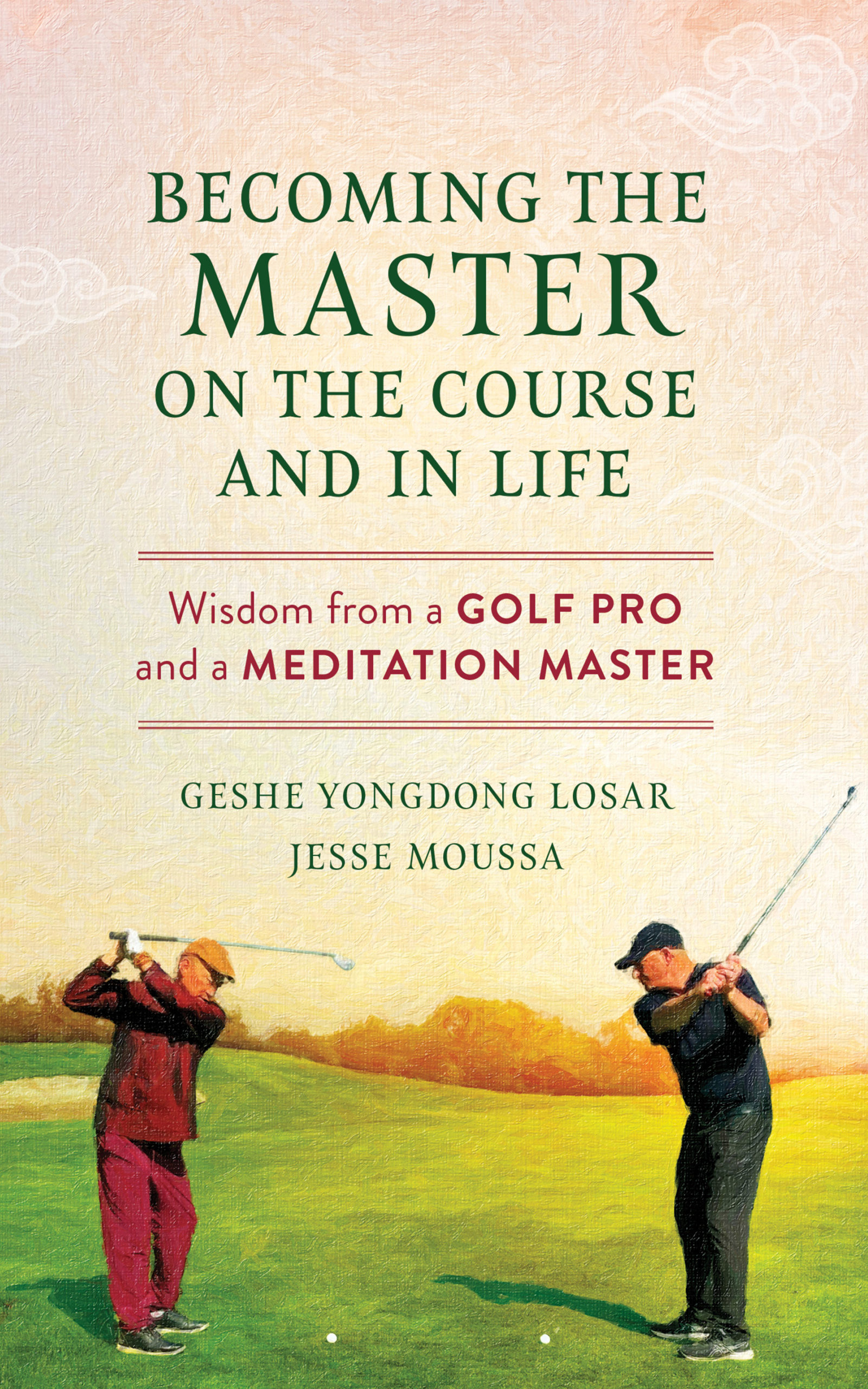 Ever feel like you’ve invested in the best equipment, taken countless lessons, and put in endless practice—yet your game just isn’t improving? Or that your shots look flawless on the range but fall apart the moment you’re in a real match? Maybe you’ve walked off the course frustrated—with yourself, your swing, or even the game itself—forgetting that golf is actually meant to be enjoyable.
Enter a Buddhist master from Tibet, Geshe YongDong Losar, and a golf pro, Jesse Moussa. Drawing on decades of golf experience and centuries of Buddhist wisdom, they team up to reveal the mental side of the sport: how to eliminate distraction, maintain focus and equilibrium, and let your skills grow naturally—like the grass.

| There are no products in your cart. |