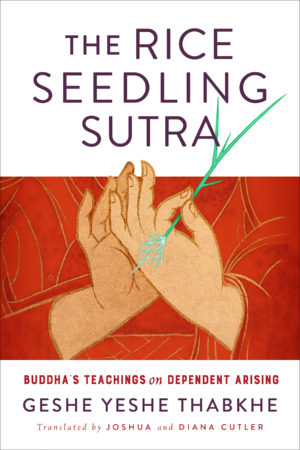
THE RICE SEEDLING SUTRA
Buddha’s Teachings on Dependent Arising
One of Tibet’s great scholars presents the Buddha’s profound teachings on the laws of karma and dependent arising.
In the Rice Seedling Sutra, the Buddha unpacks the law of cause and effect. He notes how in the natural world, a seed becomes a sprout, which produces a flower, which bears fruit. A seed has no intention to sprout; when the right conditions are assembled the fruit arises. Similarly, when our senses encounter an object, a sense consciousness arises naturally, without our intending it. This, says the Buddha, is also how karma works and how actions performed out of ignorance create suffering, whether we want it or not. And this same law of causality also governs enlightenment—when the right conditions are assembled, awakening is assured.
In many sutras like this one, the Buddha explains that to understand his Dharma is to understand dependent arising. Geshe Yeshe Thabkhe explores dependent arising, and the corollary teaching of emptiness, through this sutra and others. Commenting on the works of Indian masters such as Śāntarakṣita, he shows how belief in a creator god is incompatible with dependent arising, and by illuminating the teachings of Nāgārjuna and Candrakīrti, he shows how we do—and do not—exist.
Geshe Yeshe Thabkhe was among the last generation of scholars to be trained in Tibet before the Chinese occupation. He has been teaching Westerners for decades, having worked with top scholars in the United States, and he is especially familiar with this sutra, having translated the commentary by Kamalaśīla into Hindi. Here his deep familiarity, combined with his extensive command of the Buddhist scriptures, allows him to present the Buddha’s words in a rich and authoritative context.
About the Author
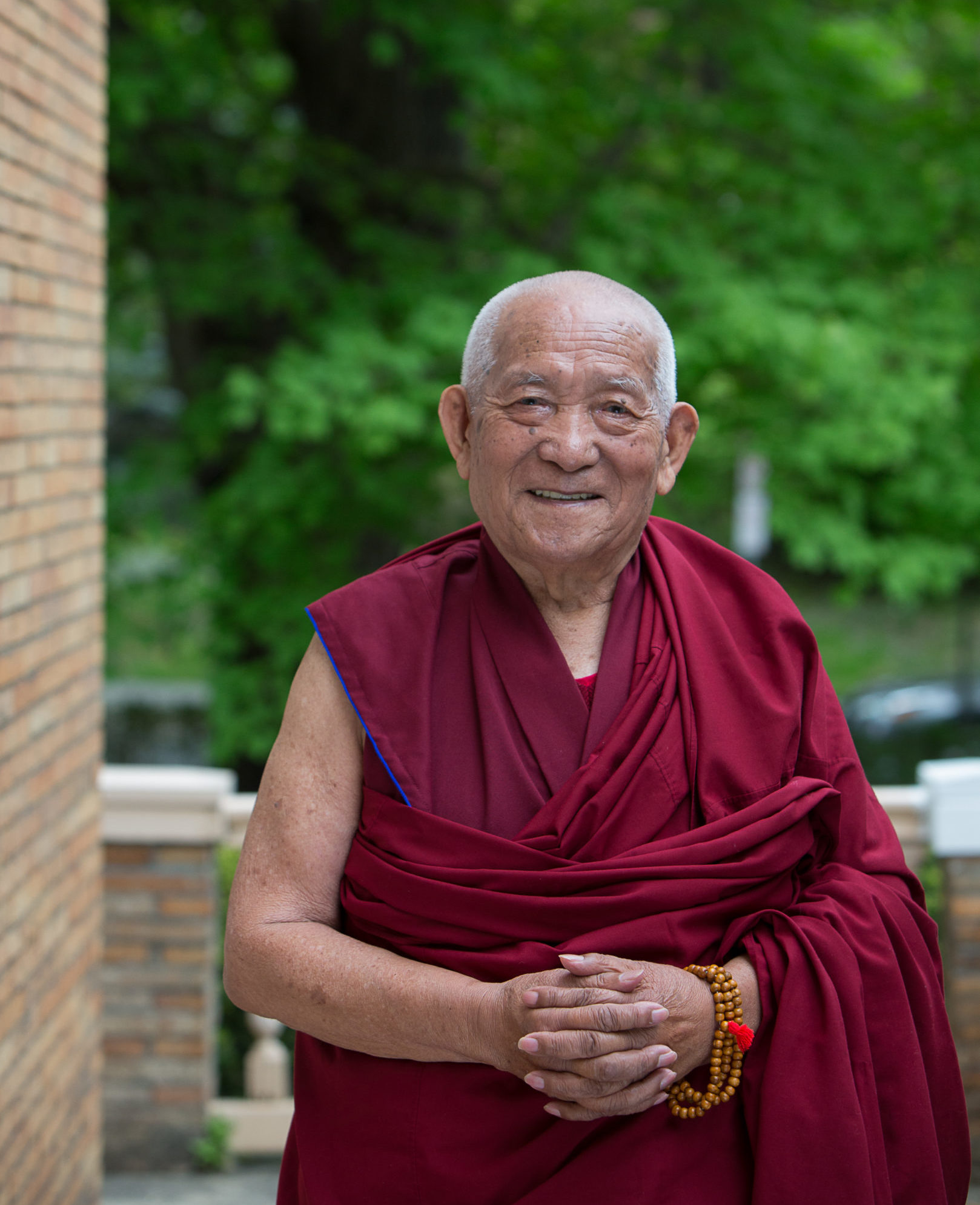
Professor Geshe Yeshe Thabkhe was born in 1930 in Lhokha, Central Tibet, and became a monk at Drepung Loseling Monastery at the age of thirteen. After completing his studies in 1969, Geshe Thabkhe was awarded the highest academic degree offered in the Geluk school of Tibetan Buddhism. Since 1972, he has served as professor of the Indian tradition of Buddhist philosophy at Central Institute of Higher Tibetan Studies, the only Tibetan university in India. He has also served as a lecturer at the School of Buddhist Philosophy, Leh, Ladakh, and at Sanskrit University in Sarnath. His works include Hindi translations of Tsongkhapa’s Essence of Good Explanation of the Definitive and Interpretable and Kamalaśīla’s commentary on the Rice Seedling Sutra. He was the primary traditional source for the English translation of Tsongkhapa’s Great Treatise on the Stages of the Path. He is a resident teacher at the Tibetan Buddhist Learning Center in New Jersey and has also taught at Drepung Loseling in Georgia, Jewel Heart in Michigan, and Sravasti Abbey in Washington State.
Photo by Armen Elliott.
Book Information
- eBook
- 176 pages pages
- $17.99
- ISBN 9781614296447
- Paperback
- 176 pages pages, 6 x 9 inches
- $20.95
- ISBN 9781614296430
Praise
We often hear that ‘dependent arising’ is the core of what the Buddha taught. In the Rice Seedling Sutra, Geshe Yeshe Thabkhe explains exactly what this means. Any reader will benefit from this kind teacher’s lucid expression of wisdom. He situates dependent arising within Indian and Tibetan philosophy, revealing how contemplation of this teaching frees us from the misery of confusion.
Guy Newland, Central Michigan University, author of Introduction to Emptiness
This translation of the Rice Seedling Sutra and Geshe Yeshe Thabkhe’s masterful commentary on it is a thorough explanation of all facets of dependent arising brought together in one book. For those who want to fully comprehend this ‘slogan of the Buddha,’ as His Holiness calls dependent arising, this work will be invaluable.
Gavin Kilty, professional translator of Tibetan texts and winner of the 2017 Shantarakshita Award for Excellence in Translation
Dependent arising, especially when paired with emptiness, may be the most crucial philosophical notion within Mahayana Buddhist philosophy, and given its tremendous importance, dependent arising lies at the intersection of numerous subtle and complex issues. The mark of a truly great scholar, however, is the ability to present such a profound and intricate topic in ways that are not only highly learned but also remarkably clear and accessible. Geshe Yeshe Thabkhe, certainly one of the greatest living Tibetan Buddhist philosophers, unfolds the meaning of dependent arising through his commentary—at once traditional and original—on a highly influential discourse by the Buddha. Accessible for those who are early in their study of Buddhism, and yet also rewarding for experienced students and scholars, the Rice Seedling Sutra is remarkable evidence that Tibetan Buddhism remains a vibrant tradition.
John D. Dunne, Distinguished Professor of Contemplative Humanities, University of Wisconsin–Madison
Geshe Thabkhe-la is a renowned master, well known in the Three Great Monasteries. His commentary on The Rice Seedling Sutra will be a tremendous benefit for Western Dharma practitioners on their path to realizing the nature of reality through the teaching of the twelve links of dependent origination. This is a fundamental philosophical view of the Buddha’s teaching. It is a tremendous resource for scholars and practitioners.
Yangsi Rinpoche, president, Maitripa College
Discover More
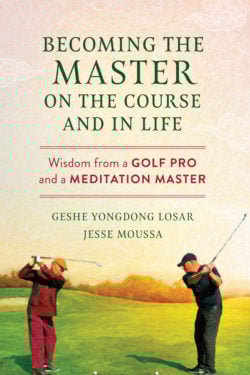
Becoming the Master on the Course and In Life
Now available! Save 20% with code BTM20 until February 3.
On the course or in your mind—golf is a game of balance. Here, timeless Buddhist teachings meet golf-pro expertise to elevate every part of your game.
Ever feel like you’ve invested in the best equipment, taken countless lessons, and put in endless practice—yet your game just isn’t improving? Or that your shots look flawless on the range but fall apart the moment you’re in a real match? Maybe you’ve walked off the course frustrated—with yourself, your swing, or even the game itself—forgetting that golf is actually meant to be enjoyable.
Enter a Buddhist master from Tibet, Geshe YongDong Losar, and a golf pro, Jesse Moussa. Drawing on decades of golf experience and centuries of Buddhist wisdom, they team up to reveal the mental side of the sport: how to eliminate distraction, maintain focus and equilibrium, and let your skills grow naturally—like the grass.
This book is your opportunity to learn from two masters how to meet the game with presence, balance, and joy—and to step up to the ball with confidence every time.
Learn about Geshe YongDong’s previous book Calm Breath, Calm Mind.
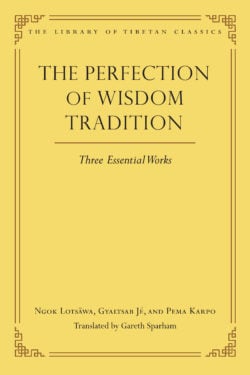
The Perfection of Wisdom Tradition
The perfection of wisdom (prajñāpāramitā) is a key element of the path in Mahāyāna Buddhism. Wisdom here is the transcendent wisdom of a bodhisattva who has penetrated the nature of reality, the emptiness (śūnyatā) of all things. Sutras that take the Perfection of Wisdom as their name emerged in the centuries before and after the start of the Common Era and became foundational for the nascent Mahāyāna. These include the well-known Heart Sūtra and Diamond Cutter Sūtra as well as the Perfection of Wisdom sutras in eight thousand and a hundred thousand lines.
Study of the Perfection of Wisdom sutras in Tibet has historically been through commentaries on the Ornament for the Clear Realizations (Abhisamayālaṃkāra), a short verse distillation in eight chapters attributed to Maitreya that was expanded in India by such figures as Asaṅga, Haribhadra, and Ārya-Vimuktisena. The three works in the present volume reflect the diversity of the Tibetan commentarial tradition on these Indian works.
Ngok Loden Sherab’s (1057–1109) Topical Summary marks the beginning in Sangphu Monastery of the most influential Perfection of Wisdom commentarial tradition. Ngok’s short work leads the reader briskly through the Abhisamayālaṃkāra’s seventy topics, presenting what would become the standard framework for explaining the Perfection of Wisdom in Tibet. The entirety of Haribhadra’s Vivṛti commentary has been embedded in Ngok’s text.
Gyaltsab Darma Rinchen’s (1364–1432) Way to Practice the Sequence of Clear Realizations, structured as a defense of the meditation system set forth by his guru Tsongkhapa in the Great Treatise on the Stages of the Path to Enlightenment, links the stages of the path expanded into the seventy topics with the actual practices of an accomplished yogi. Working outward from the middle of the Abhisamayālaṃkāra’s fourth chapter, it explains how the Perfection of Wisdom is integrated into a total and complete meditational practice for the attainment of buddhahood.
The great Drukpa Kagyü scholar Kunkhyen Pema Karpo’s (1527–92) Sacred Words of Lord Maitreya is the most detailed and systematic of the three works, supplementing explanations of the Perfection of Wisdom based on the Abhisamayālaṃkāra with verses from the Mahāyānasūtrālaṃkāra (Ornament for the Mahāyāna Sūtras) and the Uttaratantra (Sublime Continuum). This work as presented here includes within it a complete translation of the Abhisamayālaṃkāra’s eight chapters.
Learn more about the Library of Tibetan Classics
Learn about becoming a benefactor of the Library of Tibetan Classics
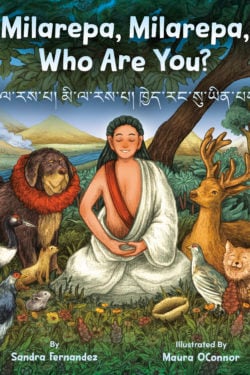
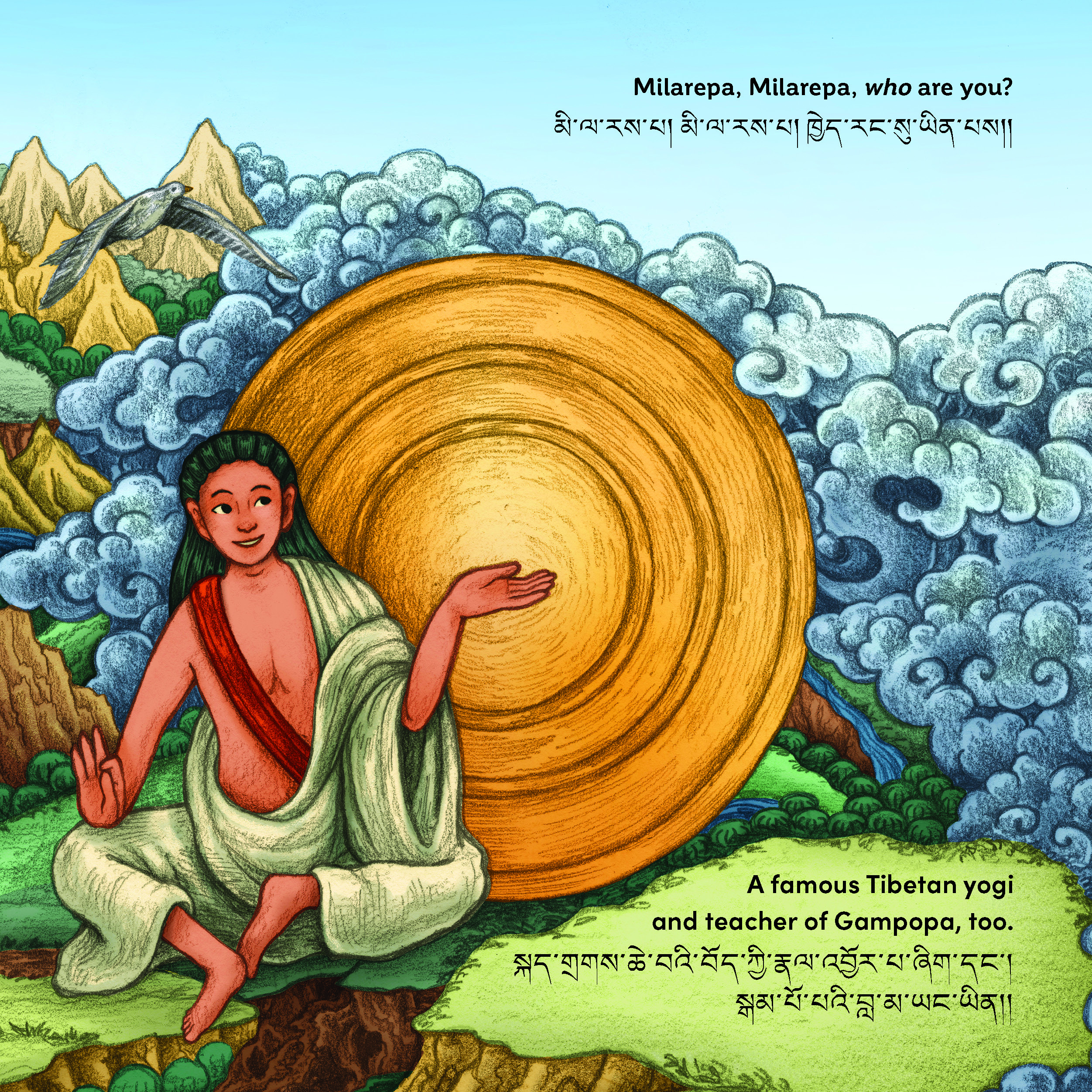
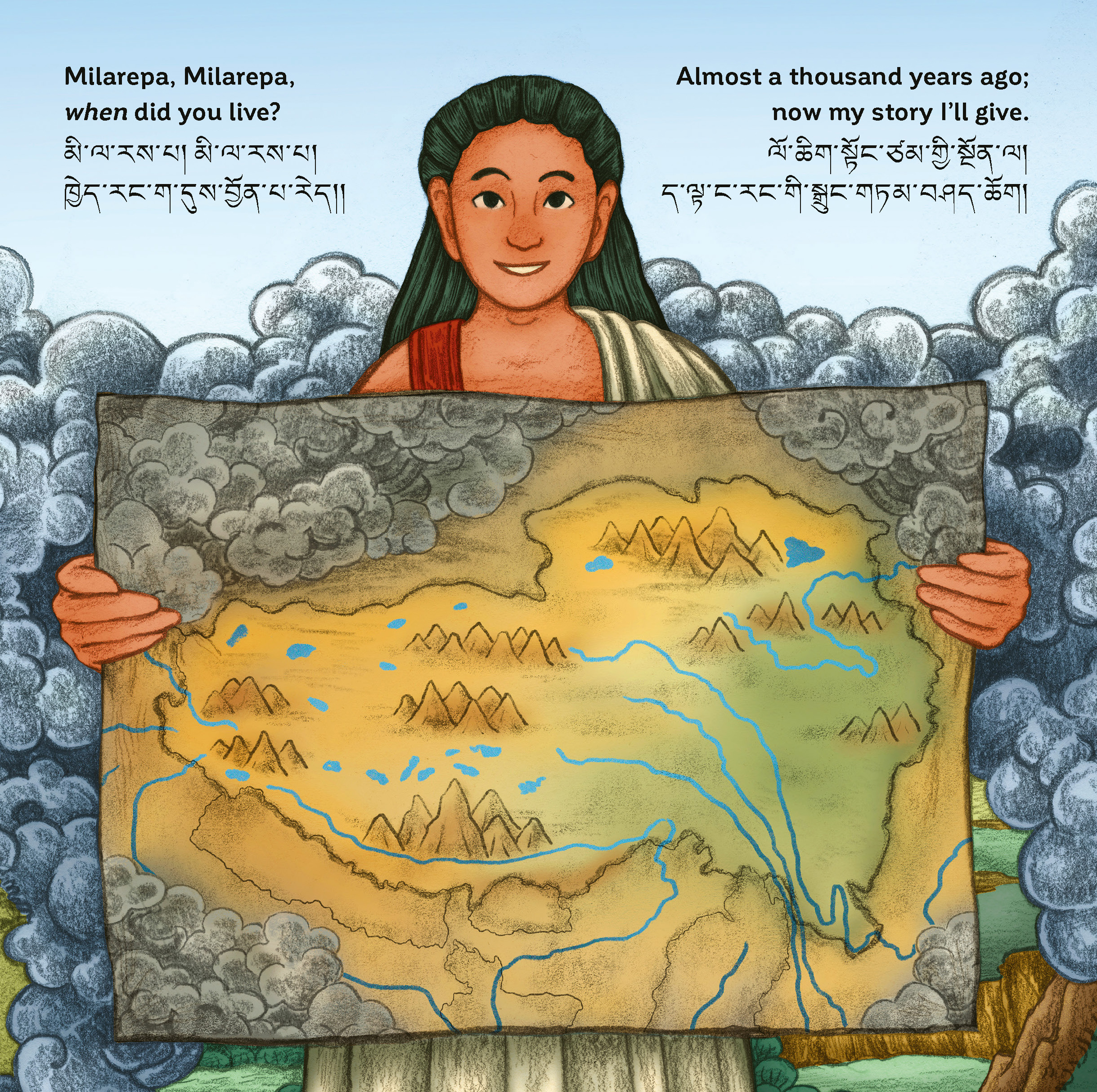
Milarepa, Milarepa, Who Are You?
A charming, beautifully illustrated, bilingual book about one of Tibet’s greatest spiritual teachers—sure to inspire awareness, compassion, and wisdom in children and adults alike that includes an online guide for parents and teachers.
Milarepa is celebrated throughout the Himalayas as one of the most inspiring Buddhist figures from Tibetan history. This beautifully illustrated telling of his life and teachings, with Tibetan translation, lets children explore his extraordinary story. Milarepa went through an incredible transformation, overcoming suffering and his own misdeeds with the help of a wise teacher to become a great spiritual teacher in his own right.
Through the story and teachings of Milarepa, we can see that it is always possible to let our inner goodness shine, no matter what we’ve done in the past. Every moment creates a new opportunity to settle the mind and open the heart. Milarepa’s resilience, fearlessness, mental clarity, and compassion have been beacons of inspiration for a thousand years and resonate as deeply today as they have through the centuries.
To honor Milarepa’s spontaneous songs—classically known as dohas in Sanskrit, which communicated his experiences to others—this book is written in poetic form. It explores the wisdom of his teachings in the form of a rhythmic, call-and-response duet.
Click here to receive an online guide for parents and teachers that further expands on the themes of the book by providing lesson ideas, meditation activities, and guidance for learning about language, history, and art.
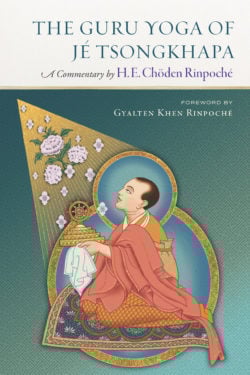
The Guru Yoga of Jé Tsongkhapa
Explore the guru yoga practice of Jé Tsongkhapa with a legendary meditation master.
The Hundreds of Deities of Tuṣita is an inspiring and well-loved guru yoga practice that originated from Jé Tsongkhapa himself and was disseminated by the First Dalai Lama. In this book, Chöden Rinpoché—a celebrated scholar who was chosen as a debate partner for His Holiness the Dalai Lama, as well as an accomplished yogi who spent nineteen years in solitary retreat—offers two different commentaries to guide the reader’s understanding.
Rinpoché’s first commentary is based on the tantric oral tradition as presented by the great lama and scholar Pabongkha Dechen Nyingpo in his own inspired commentary on The Hundreds of Deities of Tuṣita, called A Treasury of Precious Jewels, which is presented here in full. Rinpoché adds clarifying instruction to Jé Pabongkha’s work, bringing out the deeper meaning of the text and revealing how ordinary practitioners may understand and apply Pabongkha’s instruction. The second commentary from Rinpoché is a condensed commentary based on the sūtra tradition. Thus, the reader is treated to two different perspectives of the guru yoga practice of Jé Tsongkhapa.
Previously published as Opening the Door of Blessings, this edition has been revised and updated, and is an essential edition to any practitioner’s library.
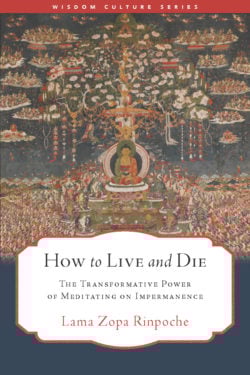
How to Live and Die
What death is, how we die, what minds we need at death and what happens after death—only by knowing about death and rebirth can we actually fully understand what life is and so learn how to live fully.
—Lama Zopa Rinpoche
There is arguably no truth more foundational to Buddhism than this: everything is impermanent. We can see this in the world all around us; old systems break down, relationships change. Death comes for those we love and, inevitably, for us.
In this book, the late, beloved teacher Lama Zopa Rinpoche walks us through the traditional, revelatory practices of meditating on the fact of impermanence and even—especially—on death itself. Rather than shy away from this reality, we look straight at it, and thus we learn not only how to not fear death, but how to live.
Atiśa’s Stages of the Path to Awakening
This book contains a lost Stages of the Path (Lamrim) work composed by the originator of the genre, Atiśa, one of the greatest Indian Buddhist masters to ever set foot in Tibet.
Nearly a millennium ago, the great Indian Buddhist master Atiśa Dīpaṃkaraśrījñāna (ca. 982–1054) wrote a guidebook for realizing all the stages to awakening at the repeated request of his closest Tibetan disciple. Atiśa is famously the author of the Lamp for the Path to Awakening (Bodhipathapradipa), a short work in verse, but this longer prose work has been virtually unknown, even in Tibet—until now. Atiśa’s Stages of the Path Awakening (Bodhipathakrama), translated here, synthesizes all aspects of Buddhist practice, from the very beginning of the path—reflecting on the fortunate opportunity of human rebirth—up through to attaining omniscient buddhahood by nondual meditation. The Indian master’s faithful disciple Dromtönpa kept these teachings secret, and they were only transmitted to select disciples in a closely guarded transmission, but the lineage died out centuries ago, after Dromtönpa’s Kadam school was eclipsed by history.
Now this significant work of Buddhist path literature has become available owing to recently recovered manuscripts of the Kadampas. This book offers a study and complete translation from the Tibetan of this monument of guidance on the Buddhist path accompanied by the commentaries and ritual texts that were transmitted alongside Atiśa’s text. Apple’s substantial introduction includes a structural comparison with Atiśa’s famous work, charts the transmission lineage for the present work before it died out, and explores various hypotheses for why their fates diverged. Recovered from the contingencies of history, this book brings to life one of the most holistic and integrated approaches to the highest realizations of the Indian Buddhist path ever transmitted in Tibet.
Sakya Paṇḍita
A set of classic biographies of Sakya Paṇḍita—one of Tibet’s greatest scholars and religious masters.
Sakya Paṇḍita Kunga Gyaltsen (1182–1251) was a renowned Tibetan polymath, scholar, statesman, and religious master, and one of the most famous and consequential figures in the history of Tibet. The three classic biographies included here contain fascinating firsthand accounts of key events in Sakya Paṇḍita’s life, covering his family ancestry, early education, interactions and debates with other sects, travels to Mongolia and his diplomacy at the Mongol court, and a detailed account of the miraculous events that occurred in the last weeks of his life.
The Great Hūṃ
Śāntideva’s Way of the Bodhisattva (Bodhicaryāvatāra) is without a doubt one of the greatest masterpieces of Indian Buddhism and the single most influential text on Mahāyāna ethical theory. Since it was composed in around the eighth century, it has continuously animated the living tradition, especially in Tibet but now in the West as well, as more translations have become available. Its poetic evocations of the spirit of awakening allow readers to enter the mind of the bodhisattva.
Its longest commentary in any language is the one translated here, by the nineteenth-century master Minyak Kunzang Sönam. It came to be known as the Great Hūṃ because it fills the entirety of the third or hūṃ volume of the author’s collected works. Citing hundreds of sūtras, he shows how Śāntideva’s verses are beautifully integrated within, and express, the Buddhist textual universe. In particular, he ties Śāntideva’s verses with the Anthology of Training, the thematic collection of scriptural citations also compiled by Śāntideva, creating a detailed tapestry of Mahāyāna thought and practice. This volume presents Kunzang Sönam’s commentary on the first eight chapters, detailing the generation of the spirit of awakening, the cultivation of positive qualities, and the practice of meditation. Embedded in the commentary is a fresh translation of Śāntideva’s verses, making this an unparalleled guide to appreciating their layers of meaning and applying them in one’s practice and life.
You can access the translation of Śāntideva’s verses here.
You can access the complete native outline (sa bcad) here.
Yoga of the Natural State
Experience for the first time in English the aural lineage of the Great Perfection Dzogchen tradition, expertly brought to life by the practitioner and translator Ācārya Malcolm Smith.
Longchen Rabjam, or Longchenpa as he is popularly known, stands as one of the great Nyingma masters of Tibetan Buddhism, producing a wealth of texts in the Dzogchen, or Great Perfection, tradition. This volume presents eight texts found in two collections of Longchenpa’s writings—the Lama Yangtig and the Zabmo Yangtig. These texts record a special experiential tradition of Great Perfection teachings by Chetsun Sengé Wangchuk to a single student in the eleventh century, a tradition passed down mouth-to-ear, one student at a time, until it was set down in writing by Longchenpa in the mid-fourteenth century.
While Longchenpa’s writings on the Seventeen Tantras are widely known, his writings on the Dzogchen aural lineage have received little attention, even though Tibetan histories show that it is the aural lineage that ensured the survival of the Great Perfection lineage. With this book of translations, we now have for the first time in English these records of the most important aural lineage in the Great Perfection tradition.
Unlike the arcane and difficult textual tradition associated with the Seventeen Tantras, the aural lineage teachings are experiential, easy to understand and practice, straightforward, and written in relatively simple language rich with similes and metaphors. The texts included in Yoga of the Natural State concern all aspects of the Great Perfection teaching, ranging from how to practice the preliminary practices, how the Great Perfection is introduced to qualified students, the correct view, meditation, and conduct of the practitioner, how to attain the state of liberation in this life, and how to recognize and attain liberation in the bardos.
Yoga of the Natural State: The Dzogchen Aural Lineage is an invaluable addition to the library of anyone interested in Great Perfection theory and practice.
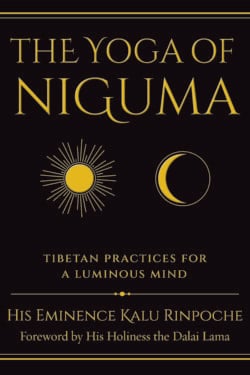
The Yoga of Niguma
Immerse yourself in the extraordinarily transcendent practice of the yoga of Niguma.
The yoga of Niguma comes to us from a secret tradition passed down over hundreds of years by Buddhist yogis in Tibet. The practice originated with the eleventh-century female yogini Niguma, who mastered and transmitted a tradition of remarkable practices that culminate in physical, spiritual, and emotional wellness. In this book, His Eminence Kalu Rinpoche, a Tibetan master who holds this lineage for today’s generation, is now opening up the practice to make its extraordinary benefits accessible to the modern yogi.
The yoga of Niguma consists of twenty-five sets of yogic exercises. Some are physically challenging while others are quite subtle in nature; all are grounded in meditation on the breath. Kalu Rinpoche illuminates the practice by sharing his own personal journey with the yoga of Niguma and how the lineage came to be. He also teaches us how we can prepare the mind for this practice with meditation and how to balance our emotions. Then, Rinpoche takes us step-by-step through the twenty-five illustrated sequences of Niguma yoga. Coauthor Michele Loew, an international yoga teacher, shares supportive Hatha yoga techniques that will bolster your Niguma yoga practice.
The yoga of Niguma is a revered method that integrates body, mind, and breath. Dive in to discover for yourself a gradual, profound groundswell of subtle awakening.
Rinpoche and Michele have recorded two full-length videos that demonstrate Niguma yoga sequences and supportive hatha yoga postures and supplement the instructions in the book. To learn more and watch the videos simply purchase the book and scan the QR code on the Additional Resources page in your copy.
You may also be interested in Rinpoche’s courses from Wisdom, Niguma’s Dream Yoga and The Illusory Body and Mind.
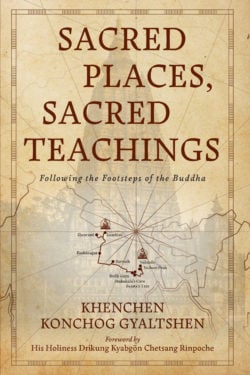
Sacred Places, Sacred Teachings
A guide to following the footsteps of the Buddha—for the pilgrim in India and at home.
The holy sites of India—Bodh Gaya, Sarnath, Shravasti, and others— became holy because the Buddha blessed them by performing his enlightened activities there. When we become holy through our practice of the Buddha’s instructions, then the places we go will be made holy, too. Through meditation practice, we can realize and capture what the Buddha described as the profundity of the mind, which is completely peaceful, free from elaboration, luminous, and uncompounded.
In this wise, heartfelt, and indispensable guide, Khenchen Konchog Gyaltshen takes us on a journey through the major holy sites for Buddhist pilgrimage by offering profound teachings related to each of the sacred places. In Bodh Gaya, the site of the Bodhi tree and the Buddha’s enlightenment, we learn of how the Buddha became enlightened and what it means to take refuge in him; we uncover the profundity of emptiness at the site where the Buddha expounded the Heart Sutra; at the place of the Buddha’s passing, we learn that the legacy of his vast teachings came about through his perfection of bodhicitta—a core quality we can master, too. In chapters based on these and other sacred places, we find that the wisdom the Buddha uncovered is available to us all.
The Buddha discovered total satisfaction, the ultimate achievement, and left instructions on how we, too, can achieve the same. We already have this great path; we just have to follow it. In that way, we experience the joy of following the footsteps of the Buddha.
You can read the introduction to Sacred Places, Sacred Teachings here.
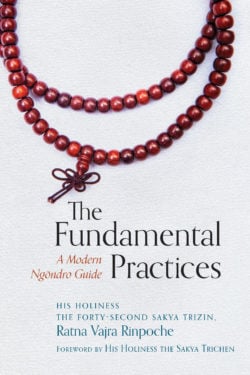
The Fundamental Practices
A wise and warm guide to the preliminary practices that lay the fundamental groundwork for traversing the path to buddhahood.
When we start on the transformational journey to enlightenment, we need a strong foundation in core Buddhist principles and practices to set us on the right track. The ngöndro, or preliminary practices, are that very foundation; they not only prepare us for advanced practice but serve us in all we do. In this guide to the common and uncommon preliminary practices, His Holiness the Forty-Second Sakya Trizin, Ratna Vajra Rinpoche, expertly gives us the grounded, practical, and illuminating teachings we need to set out on the path to buddhahood. Newcomers and seasoned practitioners alike will find practical guidance and profound wisdom to support them through their exploration of the preliminary practices.
The common preliminary practices are the four thoughts that turn the mind away from the suffering of samsara and toward the Dharma: remembering the shortcomings of samsara, remembering the preciousness of a human rebirth, remembering impermanence, and remembering the law of karma. These teachings are shared among traditions and will accompany us all the way to buddhahood. The five uncommon preliminary practices are core to further Mahayana and Vajrayana practice: going for refuge in the Buddha, Dharma, and Sangha; developing bodhichitta, the enlightened mind; Vajrasattva practice, which clears negative karma; mandala offering, which will help us accumulate merit; and guru yoga, which facilitates our realization of the nature of mind.
By using this guide, we can develop a deeper understanding of what Dharma practice truly encompasses and how we can authentically engage in it. His Holiness the Forty-Second Sakya Trizin invites us to appreciate the profound significance of these preliminary practices and experience the transformative benefits they offer—for both ourselves and all sentient beings.
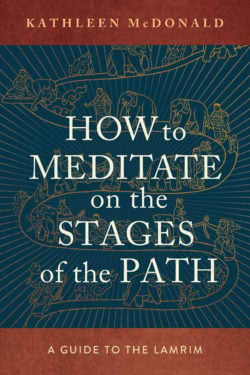
How to Meditate on the Stages of the Path
Deepen your meditation by diving into the practices of the lamrim—the stages of the path to enlightenment.
Buddhist tradition tells us that enlightenment is possible for each and every one of us. It’s actually the best thing we can do for others and for the world, but also the best thing we can do for ourselves, because it means being free from all misery, pain, depression, dissatisfaction, and negative emotions, and abiding forever in peace, joy, love, and compassion. What could be more wonderful than that?
Kathleen McDonald (Sangye Khadro), a Western nun with decades of experience and author of the bestselling book How to Meditate, guides us through the next step in our meditation practice: the transformative meditations on the Tibetan lamrim stages to enlightenment. She helps us see that the whole purpose of meditation is to transform our mind in a constructive way. For this to happen, we need to become so thoroughly familiar with the lamrim topics that they become our natural way of thinking and living our life. This warm and encouraging guide takes us through meditations on these lamrim topics, such as:
- impermanence
- refuge
- karma
- the four noble truths
- bodhichitta
- the six perfections: giving, ethics, patience, joyous effort, concentration, and wisdom
How to Meditate on the Stages of the Path offers practical advice, support, and step-by-step guidance on how to meditate on the stages of the path to enlightenment that will transform the practice of new meditators and seasoned practitioners alike.
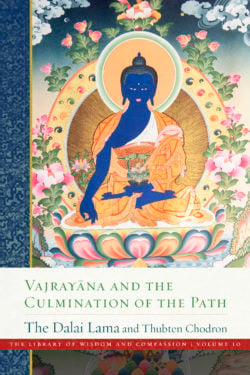
Vajrayāna and the Culmination of the Path
The final volume of the Library of Wisdom and Compassion by His Holiness the Dalai Lama takes us to the uncommon practices and realizations of Vajrayāna and the culmination of the path to the full awakening of a buddha.
His Holiness the Dalai Lama skillfully illuminates the unique qualities and complexities of Vajrayāna, as practiced in Tibet, and clarifies the method to eradicate the subtlest obscurations preventing the full awakening of a buddha. Speaking to newcomers and advanced students alike, he explains the similarities and differences of the Sūtra and Tantra paths. Having gathered many of the doubts and difficult points concerning the tantric path, he clarifies the purpose of receiving proper empowerment by qualified gurus and the ethical restraints and commitments required to enter the path of secret mantra. The paths and stages of the four tantric classes are explained, as are the generation-stage and completion-stage practices of Highest Yoga Tantra. You are introduced to the practices of clear appearance and divine identity common to all tantric sādhanas, as well as the unique practices of illusory body and actual clear light that overcome the subtlest defilements on the mind and eliminate all obscurations quickly.
The understanding of emptiness in Sūtra and Tantra is the same, but the consciousness perceiving emptiness differs. In Highest Yoga Tantra that consciousness is great bliss, which arises from knowing the methods to manipulate the channels, winds, and drops of the subtle body. In short, in Vajrayāna and the Culmination of the Path the Dalai Lama sets out the path that leads to blissful awakening and enables us to be of great benefit to all sentient beings.
Learn more about the Library of Wisdom and Compassion series.
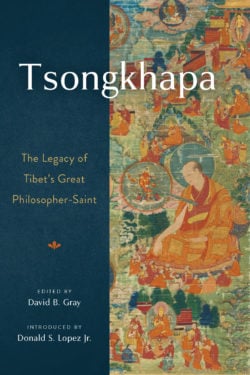
Tsongkhapa
Tsongkhapa’s seminal contributions to Buddhist thought and practice, and to the course of history, are illuminated and celebrated by some of his foremost modern interpreters.
Few figures have impacted the trajectory of Buddhism as much as the great philosopher and meditator, scholar and reformer, Tsongkhapa Losang Drakpa (1357–1419), the founder of the Geluk school of Tibetan Buddhism and teacher of the First Dalai Lama. His Ganden tradition spread throughout Central Asia and Mongolia, and today, through figures such as the Dalai Lama, who calls Tsongkhapa a second Nagarjuna, his teachings are shaping intellectual conversations and ethical practice globally. To commemorate the 600th anniversary of Tsongkhapa’s passing, a special conference was held at Ganden Monastery in India in 2019, featuring some of the best translators and interpreters of his teachings today. Highlights of those incisive summations of Tsongkhapa’s special contributions are gathered in this volume. Here we discover Tsongkhapa the philosopher, Tsongkhapa the master of the Buddhist canon, Tsongkhapa the tantric adept, and Tsongkhapa as the visionary who united wisdom to compassion.
Each of the authors featured looks at a distinct facet of Tsongkhapa’s legacy. Donald Lopez provides a global context, Guy Newland distills Tsongkhapa’s Middle Way, Dechen Rochard uncovers the identity view, Jay Garfield examines the conceptualized ultimate, Thupten Jinpa highlights the seminal importance Tsongkhapa placed on ascertainment, David Gray looks at his approach to Cakrasamvara tantra, Gavin Kilty surveys his Guhyasamaja tantra commentary, Roger Jackson surmises his views on Zen and mahamudra, Geshé Ngawang Samten examines his provisional-definitive distinction, Gareth Sparham highlights his scholastic prowess, Mishig-Ish Bataa illuminates his impact in Mongolia, and Bhiksuni Thubten Chodron presents his instructions on how to cultivate compassion.
Whether you are well acquainted with Tsongkhapa’s life and thought or you are encountering him here for the first time, you will find The Legacy of Tsongkhapa an illuminating survey of his unique explorations of the highest aspirations of humanity.
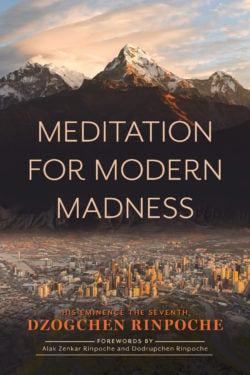
Meditation for Modern Madness
Dzogchen is an ancient Tibetan tradition that is perfect for countering the stress of our modern lives. A simple and quick method, Dzogchen is practical and direct, and open to us all—you simply need to recognize the great potential that is naturally born within everyone.
In his highly anticipated first book, His Eminence the Seventh Dzogchen Rinpoche, Jigme Losel Wangpo, shows us how our everyday lives can be turned into spiritual practice—not only to ease our stress, but to allow the true nature of our mind to reveal itself, right now, on the spot. The Dzogchen view is the highest view, the view from the top of the mountain. We need to build a platform that will hold the view, and Dzogchen Rinpoche provides the meditations and advice for living that will help you do just that. In turn, you’ll find true peace in a mind at rest.
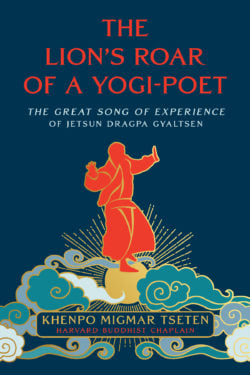
The Lion’s Roar of a Yogi-Poet
An exultant song of realization by one of Tibet’s greatest yogis, explained and elaborated upon by a beloved contemporary Tibetan teacher.
Jetsun Rinpoche Dragpa Gyaltsen (1147–1216)—revered as one of Tibet’s greatest yogis and one of the founding figures of the Sakya school of Tibetan Buddhism—composed his Great Song of Experience as a way to distill and communicate the essence of the Buddhist path to enlightenment. Shimmering with double meanings, seeming tautologies, and ribald references, Dragpa Gyaltsen’s verses resound with insights thrown out like bolts of lightning: “When mind itself is comprehended, that is Buddha; do not seek elsewhere for the Buddha!”
Beloved teacher Lama Migmar Tseten’s newly updated translation of Dragpa Gyaltsen’s Great Song brings these verses to life with a clarity and immediacy that belies the underlying challenge that these verses pose to our ordinary ways of thinking and being.
In his extensive verse-by-verse commentary, Lama Migmar unravels Dragpa Gyaltsen’s terse, enigmatic verses with clarity and humor, bringing Rinpoche’s ecstatic realization and pointed insights into conversation with twenty-first-century concerns, showing how the experiential teachings of a twelfth-century Tibetan yogi can help us understand and counteract the modern pressures of wanton consumerism, greed and inequality, isolation and loneliness, and environmental degradation. Lama Migmar’s insightful commentary opens the door to the radical vision presented by Dragpa Gyaltsen’s poetic teachings, showing us a view of the mind without center or limits, as bright as the sun, and clear and open as space.
In addition to Lama Migmar’s extensive verse-by-verse commentary, the book includes facing-page English and Tibetan editions of the root text of Great Song of Experience, and the laudatory poem Praise to Jetsun Rinpoche Dragpa Gyaltsen by Dragpa Gyaltsen’s nephew and student, the great Sakya Paṇḍita (1182–1251).
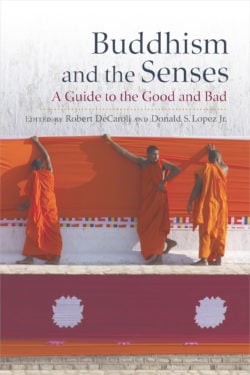
Buddhism and The Senses
Across Buddhist traditions, the five senses—sight, sound, smell, taste, and touch—are perceived both positively and negatively. Share eminent scholars’ fascination and deep insight into what makes a sensuous experience good or bad.
Following the exhibition Encountering the Buddha: Art and Practice across Asia at the National Museum of Asian art, ten eminent scholars present their insights into Buddhism’s fascinating relation with the five senses (sight, sound, smell, taste, and touch), which careens between delight and disgust, rarely finding a middle way. While much of Buddhist literature is devoted to overcoming the attachment that dooms us to rebirth in samsara, primarily by deprecating sense experience and showing that whatever brings us sensual pleasure leads only to all manner of physical and mental pain, in texts such as the Lotus Sutra, sensory powers do not offer sensory pleasure but rather knowledge, clear observation, and ability to preach the Dharma. Considering such religiously and historically contingent ambiguity, this volume presents each of the five senses in two instantiations, the good and the bad, opening up the discourse on the senses across Buddhist traditions.
Just as the museum departed from tradition to incorporate sensory experiences into the exhibition, this volume is a new direction in scholarship to humanize Buddhist studies by foregrounding sensory experience and practice, inviting the reader to think about the senses in a focused manner and shifting our understanding of Buddhism from the conceptual to the material or practical, from the idealized to the human, from the abstract to the grounded, from the mind to the body.
Includes essays by Bryan J. Cuevas, Debra Diamond, D. Max Moerman, Reiko Ohnuma, James Robson, Melody Rod-ari, Kurtis R. Schaeffer, John Strong, and Lina Verchery.