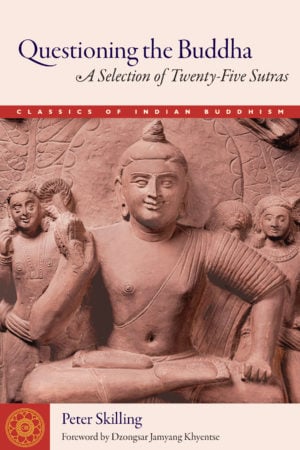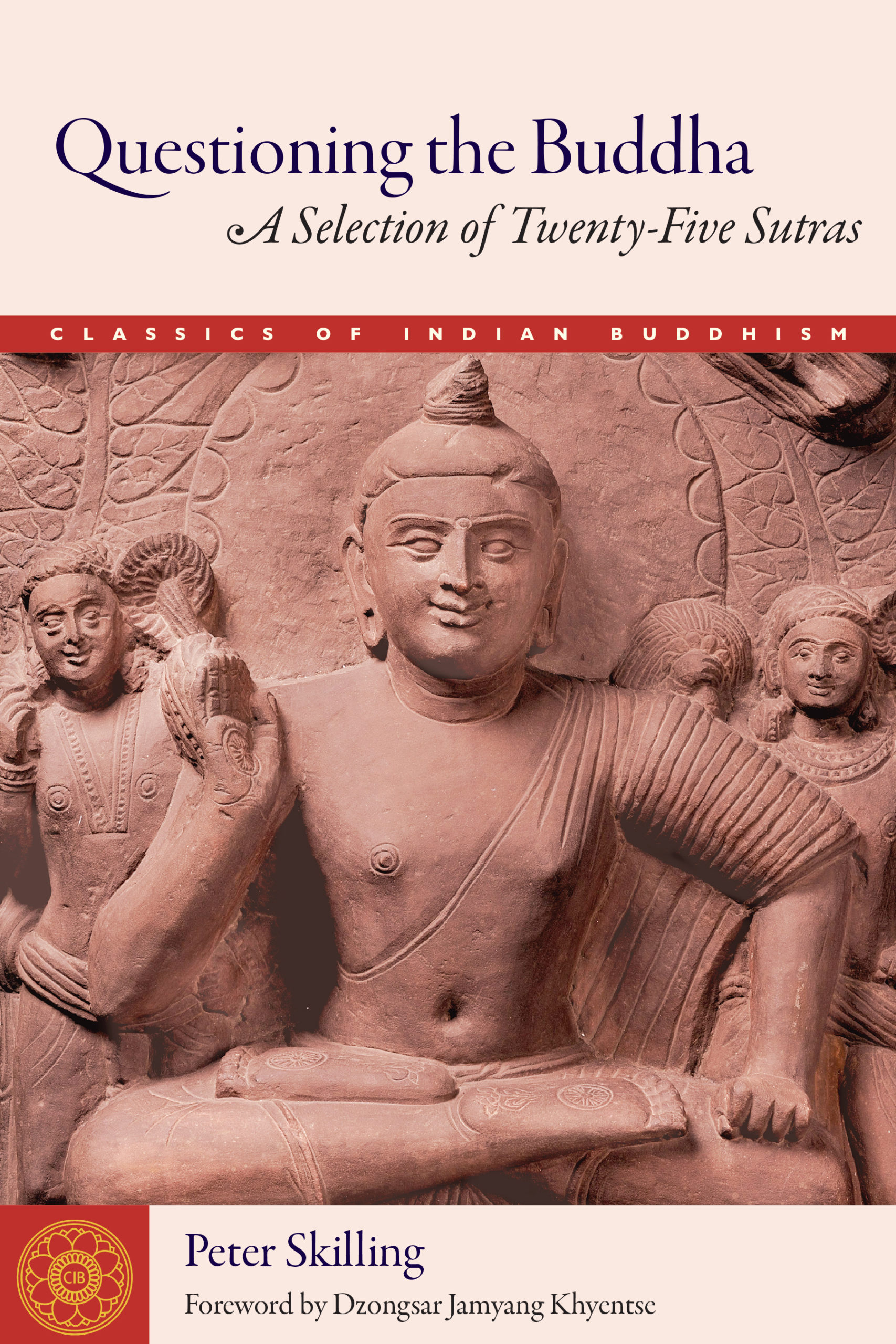
QUESTIONING THE BUDDHA
A Selection of Twenty-Five Sutras
In the forty-five years the Buddha spent traversing northern India, he shared his wisdom with everyone from beggar women to kings. Hundreds of his discourses, or sutras, were preserved by his followers, first orally and later in written form. Around thirteen hundred years after the Buddha’s enlightenment, the sutras were translated into the Tibetan language, where they have been preserved ever since. To date, only a fraction of these have been made available in English. Questioning the Buddha brings the reader directly into the literary treasure of the Tibetan canon with thoroughly annotated translations of twenty-five different sutras. Often these texts, many translated here in full for the first time, begin with an encounter in which someone poses a question to the Buddha.
Peter Skilling, an authority on early Buddhist epigraphy, archaeology, and textual traditions, has been immersed in the Buddhist scriptures of diverse traditions for nearly half a century. In this volume, he draws on his deep and extensive research to render these ancient teachings in a fresh and precise language. His introduction is a fascinating history of the Buddhist sutras, including the transition from oral to written form, the rise of Mahayana literature, the transmission to Tibet, the development of canons, and a look at some of the pioneers of sutra study in the West.
Sutras included in this volume are: Four Dharmas Not to Be Taken for Granted; The Benefits of Giving; The Exposition of Four Dharmas; The Merit of the Three Refuges; Four Dharmas Never to Be Abandoned; Advice for Bodhisatva Dharmaketu; Advice for Bodhisatva Jayamati; Sūtra Comparing Bodhicitta to Gold; Bodhisatva Maitreya’s Question about the Gift of the Dharma; Four Summaries of the Dharma Spoken to the Nāga King Sāgara; The Stanza of Dependent Arising; The Heart Formula of Dependent Arising; Prediction of the Boy Brahmaśrī’s Future Buddhahood; Kṣemavatī’s Prediction to Future Buddhahood; The City Beggar Woman; An Old Woman’s Questions about Birth and Death; The Questions of Śrīmatī the Brahman Woman; The Questions of the Laywoman Gaṅgottarā; Brahmā Sahāṃpati’s Question; Advice to King Prasenajit; Passage to the Next Life; Instructions for King Bimbisāra; Instructions for King Udayana; Buddhas as Rare as a Grain of Golden Sand; and Predictions on the Eve of the Great Final Nirvāṇa.
Learn more about the Classics of Indian Buddhism series.
About the Author

Peter Skilling is a special lecturer at Chulalongkorn University, Bangkok, and an honorary associate, Department of Indian SubContinental Studies, University of Sydney, Australia. Until his retirement in 2017, he was a professor of the French School of Asian Studies (EFEO) based in Bangkok. He was awarded an honorary doctorate in the humanities by Chulalongkorn University in 2020. He is an honorary member of the Siam Society, Bangkok, and in 2017 he was elected an honorary fellow of the Asiatic Society of Mumbai. He has been visiting professor at Harvard University (2000), the University of California at Berkeley (2001), Oxford University (2002), Sydney University (2009), Soka University (2009), and Savitribai Phule Pune University (2016–17). He has published widely on the Buddhist literature, history, and epigraphy of South and Southeast Asia.
Book Information
- Paperback
- 680 pages, 6 x 9 inches
- $49.95
- ISBN 9781614293934
- eBook
- 680 pages
- $38.99
- ISBN 9781614294085
Praise
“In this volume, prose and verse join beautifully to celebrate the Dharma. The selections show how rich, how diverse, and how wonderful the Kangyur is—and how little we know about it.” —from the foreword by Dzongsar Jamyang Khyentse
“A stimulating and delightfully readable book . . . Peter Skilling is probably the most versatile scholar of Buddhology today, equally conversant with philosophy, history, ritual, doctrine, art, and iconography. He has selected from the Tibetan twenty-five sutras that were lost in India long ago, which he has translated into elegant English. His introduction and first two appendixes together form a most lucid and up-to-date discussion of Buddhist thought that should be compulsory reading in any field of Buddhology.” —Pratapaditya Pal, author of Quest for Coomaraswamy: A Life in the Arts
“Peter Skilling’s selection of Buddhist sutras comes with an informative introduction, a meticulous exploration of sources, and an attractive and reliable rendering in English. Textual discoveries and expositions of this quality are a substantial contribution to Buddhist studies.” —Romila Thapar, professor emerita of history, Jawaharlal Nehru University, New Delhi
“A magnificent scholar and a magnificent human being, Peter Skilling has always been an example for us all, for his unbounded erudition combined with an unflinching modesty. This precious volume will serve as a reference and an inspiration to present and future generations.”
—Matthieu Ricard, Shechen Monastery, Nepal
Discover More
The Seven Siddhi Texts
Available early! Use code SST20 to receive 20% until December 23.
The first English-language translation (with rich historical introduction and extensive annotation) of a key group of Indian Buddhist tantric texts that have had profound influence on the Tibetan Buddhist tradition.
The Seven Siddhi Texts is a key collection of Indian Buddhist tantric exegetical treatises that have shaped the interpretation of unexcelled yoga tantra and Mahāmudrā (Great Seal) practice in Tibet from the eighth century ce to the present. The scholar-yogi authors of these seven texts—drawing upon their scriptural knowledge and personal insight—clarify the intended meanings underlying cryptic, seemingly antinomian passages in root tantras such as the Esoteric Community Tantra (Guhyasamāja-tantra) pertaining to sex, violence, and magical powers, which have proved controversial for many traditional and modern scholars. These seven treatises come from the famed mahāsiddha (great adept) tradition, which often defied the rigid social, religious, and gender norms of premodern India in quest of nondual wisdom. The translator’s introduction places the collection in its Indian sociohistorical context, traces its reception in Tibetan Mahāmudrā practice lineages, and addresses modern misinterpretations. As a window into the earliest Indian Buddhist tantric communities, the Seven Siddhi Texts is a treasure for both practitioners and scholars of these increasingly popular subjects.
This volume is part of the Treasury of the Buddhist Sciences series, copublished by the American Institute of Buddhist Studies (AIBS) and Wisdom Publications in association with the Columbia University Center for Buddhist Studies and Tibet House US. You can learn more about the series here.
The Perfection of Wisdom Tradition
The perfection of wisdom (prajñāpāramitā) is a key element of the path in Mahāyāna Buddhism. Wisdom here is the transcendent wisdom of a bodhisattva who has penetrated the nature of reality, the emptiness (śūnyatā) of all things. Sutras that take the Perfection of Wisdom as their name emerged in the centuries before and after the start of the Common Era and became foundational for the nascent Mahāyāna. These include the well-known Heart Sūtra and Diamond Cutter Sūtra as well as the Perfection of Wisdom sutras in eight thousand and a hundred thousand lines.
Study of the Perfection of Wisdom sutras in Tibet has historically been through commentaries on the Ornament for the Clear Realizations (Abhisamayālaṃkāra), a short verse distillation in eight chapters attributed to Maitreya that was expanded in India by such figures as Asaṅga, Haribhadra, and Ārya-Vimuktisena. The three works in the present volume reflect the diversity of the Tibetan commentarial tradition on these Indian works.
Ngok Loden Sherab’s (1057–1109) Topical Summary marks the beginning in Sangphu Monastery of the most influential Perfection of Wisdom commentarial tradition. Ngok’s short work leads the reader briskly through the Abhisamayālaṃkāra’s seventy topics, presenting what would become the standard framework for explaining the Perfection of Wisdom in Tibet. The entirety of Haribhadra’s Vivṛti commentary has been embedded in Ngok’s text.
Gyaltsab Darma Rinchen’s (1364–1432) Way to Practice the Sequence of Clear Realizations, structured as a defense of the meditation system set forth by his guru Tsongkhapa in the Great Treatise on the Stages of the Path to Enlightenment, links the stages of the path expanded into the seventy topics with the actual practices of an accomplished yogi. Working outward from the middle of the Abhisamayālaṃkāra’s fourth chapter, it explains how the Perfection of Wisdom is integrated into a total and complete meditational practice for the attainment of buddhahood.
The great Drukpa Kagyü scholar Kunkhyen Pema Karpo’s (1527–92) Sacred Words of Lord Maitreya is the most detailed and systematic of the three works, supplementing explanations of the Perfection of Wisdom based on the Abhisamayālaṃkāra with verses from the Mahāyānasūtrālaṃkāra (Ornament for the Mahāyāna Sūtras) and the Uttaratantra (Sublime Continuum). This work as presented here includes within it a complete translation of the Abhisamayālaṃkāra’s eight chapters.
Learn more about the Library of Tibetan Classics
Learn about becoming a benefactor of the Library of Tibetan Classics
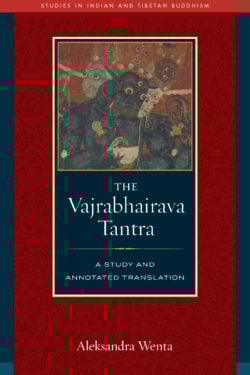
The Vajrabhairava Tantra
A groundbreaking work on the little-studied Indian origins of an influential tantric Buddhist practice along with a fresh English translation.
The deity Vajrabhairava, or Yamantaka, is well known as the central figure of tantric practice in multiple lineages of Tibetan Buddhism and is also found in Chinese and Japanese Buddhism. Less is known about its foundational Indian context. The Vajrabhairava Tantra, dedicated to the buffalo-headed deity Vajrabhairava, arose around the eighth century and had a considerable impact on the formation of religious praxis in the medieval Indian Buddhist world. This book contains a translation of the Vajrabhairava Tantra from the recently discovered Sanskrit text and a comprehensive study of its elements, of its origins and Indian commentators, and of the history of its transmission to Tibet. The annotation to the translation excerpts all six Indian commentaries on the tantra found in the Tibetan canon.
One highly innovative contribution this work makes to the fields of tantric Buddhist studies and, more generally, to South Asian religions is the way it breaks down traditional disciplinary boundaries between tantra and magic. It shows that the genesis of tantric traditions cannot be reduced to a one-way influence of Hindu Shaivism on Buddhism or vice versa, but indicates a widespread “culture of magic,” a common “ritual syntax,” that crossed sectarian, linguistic, and socio-cultural boundaries, one that came to be significantly diminished in later Shaiva and Buddhist tantras.
The study comprises the first half of the book, and the second half is the translation, which explains the construction of the mandala, the magical applications of the practice, the extraction of the mantra, the visualization, and the preparation of the pata painting and the homa fire ritual. A dozen color plates illustrate Vajrabhairava in his Solitary Hero and other forms along with mandalas of five different lineages, keys for which are provided in the appendix.
The only previous study of the Vajrabhairava Tantra relied solely on Tibetan and Mongolian sources. By relying on the newly discovered Sanskrit manuscript, this new translation is able to correct numerous inaccuracies. Moreover, the earlier study included only three of six canonical commentaries on the root text incorporated here, passing over the key commentaries by Akṣobhya and Kṛṣṇācārya.
Learn more about the Studies in Indian and Tibetan Buddhism series.
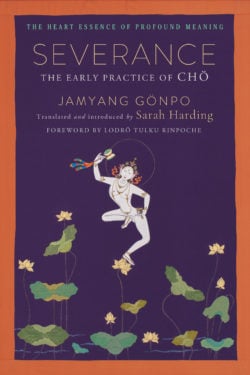
Severance
An ancient Buddhist guide to confronting difficult circumstances and letting go of clinging to the ego.
Severance, or Cho, is the Tibetan Buddhist practice of facing one’s fears. In three remarkable texts lucidly translated and introduced by Sarah Harding, the thirteenth-century Severance master Jamyang Gönpo shares advice that goes straight to the heart of both understanding and experiencing the practice. For hundreds of years, Severance has remained essentially an instruction on coping with stressful situations that provoke fear and, beyond that, a way to actively seek out such circumstances in order to test one’s realization of perfect wisdom.
The single overall directive of the first two texts in this volume—the Heart Essence of Profound Meaning root verses and their commentary, The Big General Guide to Severance—is to seek out and directly confront difficult circumstances. Here, these difficulties are often anxieties related to spirits in the dark of night in haunted places. This practice acts as a means to recognize emptiness—the lack of intrinsic existence of all phenomena—as well as a testing ground of one’s former realizations and studies of that emptiness from the Perfection of Wisdom. The texts are notable for their lack of instruction on ritualized Severance involving body sacrifice, which later works emphasize; in these texts, the heart of Severance is letting go of clinging to the self and reification of existence. And as Jamyang Gonpo was just a generation removed from Machik Labdron, the main progenitor of Severance, his methods seem to be closest to her actual teachings.
The third translation in this volume, The Seven-Day Severance Retreat Experiential Guide, is a very concise and precise instruction on putting the main intentions of the teachings into practice in the setting of a one-week retreat. The instructions are striking in that they contain no rituals, visualizations, deities, instruments, or liturgies. Jamyang Gönpo shows us how to turn our attention to the very mind of this person who is experiencing fear and the object of that fear—whether fear about demons or sickness or suffering—to see them for what they are. In doing so, we find that joys and sorrows, highs and lows, powers of gods and demons, and demonic obstacles are all mind made.
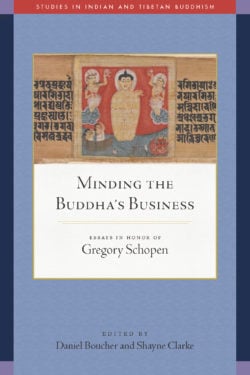
Minding the Buddha’s Business
Colleagues and former students of Gregory Schopen honor his path-breaking contributions to Buddhist studies with these articles on the early Mahayana, the monastic codes, and Buddhism’s art-historical and epigraphical remains.
This volume honors the profoundly transformative influence of Gregory Schopen’s many contributions to Buddhist studies. Eighteen articles by former students and colleagues focus on the areas of Schopen’s most noteworthy influence: the study of the Mahayana, particularly of its early sutra literature; the study of Vinaya, especially the narratives accompanying the rules for monks and nuns; and the study of Buddhist epigraphy and art history. Contributors demonstrate the ongoing significance of Schopen’s scholarship, including his very first article, on the cult of the book in the early Mahayana, published fifty years ago.
Schopen has repeatedly shown how the study of Buddhism has too often focused on scriptures and normative doctrines and not enough on the practical ideas and contexts that significantly impacted the lives of actual Buddhists. He sought to reveal these lived concerns in the massive trove of Buddhist inscriptions, which often expose the habits and ideas of the tradition’s most prominent donors (many of whom were monastics), as well as the everyday concerns of monks and nuns, whose views did not always dovetail with canonical sources. Even in his treatment of canonical sources, Schopen has shown that the standard portrait of a Buddhist monk or nun fails to match a careful reading of their law codes—his work on the Mulasarvastivada-vinaya has required scholars to substantially reimagine the legal and ritual obligations, as well as the economic concerns, that preoccupied the minds of Buddhist jurists.
Schopen has, in essence, brought the Buddha down to earth, revealing that this is precisely where most Indian Buddhists encountered him. The contributions in this celebratory volume reflect this legacy and Schopen’s considerable impact on our understanding of Buddhists in India.
Click here to see the table of contents.
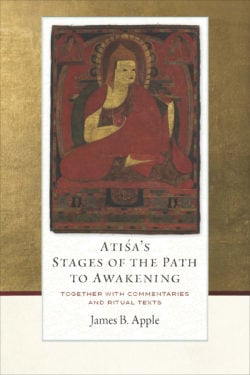
Atiśa’s Stages of the Path to Awakening
This book contains a lost Stages of the Path (Lamrim) work composed by the originator of the genre, Atiśa, one of the greatest Indian Buddhist masters to ever set foot in Tibet.
Nearly a millennium ago, the great Indian Buddhist master Atiśa Dīpaṃkaraśrījñāna (ca. 982–1054) wrote a guidebook for realizing all the stages to awakening at the repeated request of his closest Tibetan disciple. Atiśa is famously the author of the Lamp for the Path to Awakening (Bodhipathapradipa), a short work in verse, but this longer prose work has been virtually unknown, even in Tibet—until now. Atiśa’s Stages of the Path Awakening (Bodhipathakrama), translated here, synthesizes all aspects of Buddhist practice, from the very beginning of the path—reflecting on the fortunate opportunity of human rebirth—up through to attaining omniscient buddhahood by nondual meditation. The Indian master’s faithful disciple Dromtönpa kept these teachings secret, and they were only transmitted to select disciples in a closely guarded transmission, but the lineage died out centuries ago, after Dromtönpa’s Kadam school was eclipsed by history.
Now this significant work of Buddhist path literature has become available owing to recently recovered manuscripts of the Kadampas. This book offers a study and complete translation from the Tibetan of this monument of guidance on the Buddhist path accompanied by the commentaries and ritual texts that were transmitted alongside Atiśa’s text. Apple’s substantial introduction includes a structural comparison with Atiśa’s famous work, charts the transmission lineage for the present work before it died out, and explores various hypotheses for why their fates diverged. Recovered from the contingencies of history, this book brings to life one of the most holistic and integrated approaches to the highest realizations of the Indian Buddhist path ever transmitted in Tibet.
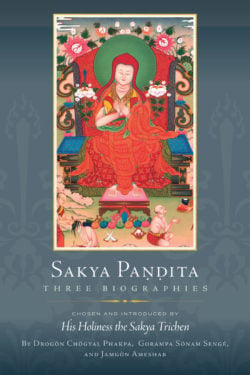
Sakya Paṇḍita
A set of classic biographies of Sakya Paṇḍita—one of Tibet’s greatest scholars and religious masters.
Sakya Paṇḍita Kunga Gyaltsen (1182–1251) was a renowned Tibetan polymath, scholar, statesman, and religious master, and one of the most famous and consequential figures in the history of Tibet. The three classic biographies included here contain fascinating firsthand accounts of key events in Sakya Paṇḍita’s life, covering his family ancestry, early education, interactions and debates with other sects, travels to Mongolia and his diplomacy at the Mongol court, and a detailed account of the miraculous events that occurred in the last weeks of his life.
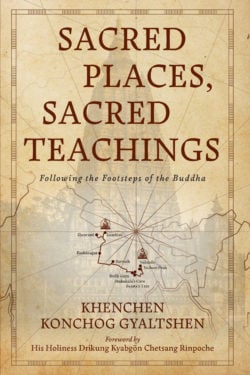
Sacred Places, Sacred Teachings
A guide to following the footsteps of the Buddha—for the pilgrim in India and at home.
The holy sites of India—Bodh Gaya, Sarnath, Shravasti, and others— became holy because the Buddha blessed them by performing his enlightened activities there. When we become holy through our practice of the Buddha’s instructions, then the places we go will be made holy, too. Through meditation practice, we can realize and capture what the Buddha described as the profundity of the mind, which is completely peaceful, free from elaboration, luminous, and uncompounded.
In this wise, heartfelt, and indispensable guide, Khenchen Konchog Gyaltshen takes us on a journey through the major holy sites for Buddhist pilgrimage by offering profound teachings related to each of the sacred places. In Bodh Gaya, the site of the Bodhi tree and the Buddha’s enlightenment, we learn of how the Buddha became enlightened and what it means to take refuge in him; we uncover the profundity of emptiness at the site where the Buddha expounded the Heart Sutra; at the place of the Buddha’s passing, we learn that the legacy of his vast teachings came about through his perfection of bodhicitta—a core quality we can master, too. In chapters based on these and other sacred places, we find that the wisdom the Buddha uncovered is available to us all.
The Buddha discovered total satisfaction, the ultimate achievement, and left instructions on how we, too, can achieve the same. We already have this great path; we just have to follow it. In that way, we experience the joy of following the footsteps of the Buddha.
You can read the introduction to Sacred Places, Sacred Teachings here.
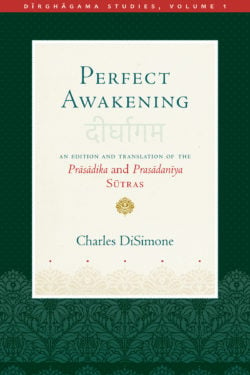
Perfect Awakening
The Long Discourses, or Dīrghāgama, is a collection of the Buddha’s most well-known sermons that has circulated widely in the Buddhist world. Parallel collections in Pali and Chinese have long been known to scholars and practitioners, but it was not until the 1990s that a Mūlasarvāstivāda manuscript transmitted in Sanskrit was discovered, a major find with the potential to reshape our understanding of Buddhism in India and Central Asia. The present volume is the first in a three-volume series to present this rare manuscript, with a study, translation, and critical edition of two of the sūtras in the collection.
Around thirty years ago, a rare bookseller in London parceled out birchbark leaves of a manuscript bundle representing an ancient scripture that had likely been unearthed in the Gilgit region of Pakistan. Even as the fragile folios entered collections in Japan, Norway, and the United States, they were identified by a scholar as belonging to the previously lost Sanskrit Dīrghāgama, the Collection of Long Discourses of the Buddha, of the Mūlasarvāstivādins. Although the forty-seven separate sūtras in this āgama have parallel transmissions extant in the Pali Digha-nikāya and the Chinese Chang ahan jing, this Sanskrit witness, copied in the eighth century, was previously known only from partial quotations and from translations in Tibetan and Chinese. The discovery was thus one of major significance in the study of Buddhist literature.
This book, one of the first presentations of this manuscript in English, provides a translation, critical reconstruction, and study of two of the sūtras in the Dīrghāgama: the Prāsādika-sūtra and the Prasādanīya-sūtra. Both sūtras offer what appears to have been late teachings of the Buddha on the nature of faith and the preeminence of the Buddha over all other teachers. The Buddhist community was evidently concerned about the coming passing of the Buddha and, in these scriptures, laid the foundation for the tradition to continue with the Buddha at the center. The Prasādanīya-sūtra, in particular, is the locus classicus for the doctrine that only one Buddha and his teachings can exist in a world system at a time, ensuring that the Buddhist community would not be tempted to follow any other teacher who had not realized perfect awakening but would hold true to the Dharma of the Buddha.
These sūtras from the Mūlasarvāstivāda tradition are made available to the public for the first time in over a thousand years with philological reconstructions and translations. They are accompanied by synoptic parallels from the corresponding Pali Long Discourses of the Theravāda tradition and the Chinese Long Discourses of the Dharmaguptaka tradition along with citations and related passages from elsewhere in Buddhist literature. In addition, the work contains a full transliteration of the birchbark folios, an introduction to the two sūtras with a study providing paleographic and textual analysis of the manuscript, and notes providing insight and explanation throughout.
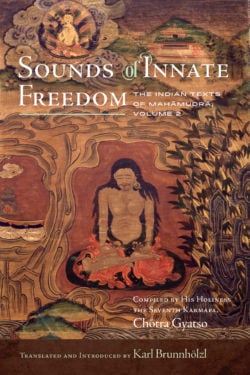
Sounds of Innate Freedom, Vol. 2
The second volume in a historic six-volume series containing many of the first English translations of the classic mahāmudrā literature compiled by the Seventh Karmapa.
Sounds of Innate Freedom: The Indian Texts of Mahāmudrā are historic volumes containing many of the first English translations of the classic mahāmudrā literature. The texts and songs in these volumes constitute the large compendium called The Indian Texts of the Mahāmudrā of Definitive Meaning, compiled by the Seventh Karmapa Chötra Gyatso (1456–1539). Translated, introduced, and annotated by Karl Brunnhölzl, acclaimed senior teacher at the Nalandabodhi community of Dzogchen Ponlop Rinpoche, the collection offers a brilliant window into the richness of the vast ocean of Indian mahāmudrā texts cherished in all Tibetan lineages, particularly in the Kagyü tradition, giving us a clear view of the sources of one of the world’s great contemplative traditions.
This volume 2 (thirty-four texts) contains two long-established sets of Mahāmudrā works: “The Sixfold Pith Cycle” and short texts of Maitrīpa’s “Twenty-Five Dharmas of Mental Nonengagement,” which present a blend of Madhyamaka, Mahāmudrā, and certain tantric principles, as well as two commentaries by Maitrīpa’s students. The vital focus of this volume is the accomplishment of true reality.
Click here to explore other volumes available in The Sounds of Innate Freedom series.
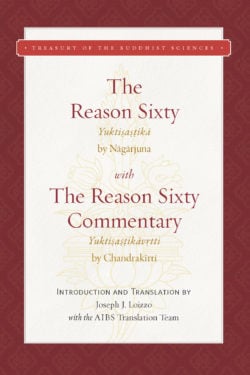
The Reason Sixty
The Reason Sixty: Second Edition presents two key Indian Buddhist philosophical masterpieces that integrate the Buddhist ethos of wisdom and compassion, with their profound relevance to contemporary thought clarified by a renowned scholar of contemplative science.
This volume contains English translations of two critical treatises of the Middle Way (Madhyamaka) Buddhist philosophical school: the Reason Sixty, by the most important of Indian thinkers Nāgārjuna (2nd century CE), and the commentary by his most influential successor, Chandrakīrti (7th century CE). These two treatises emphasize the non-foundationalist reasoning for which Madhyamaka thought is famed, here within the context of that quintessential Buddhist topic, universal compassion, thereby illuminating the nondual nature of these two fundamental components of Indian Buddhist thought. The full import of Nāgārjuna’s verses are brought to life by Chandrakīrti, whose influence in Tibetan Buddhist educational institutions remains profound to the present. Translator Joseph Loizzo, a Harvard-trained psychiatrist and Columbia-trained Buddhologist, elucidates the relevance of these two treatises to the linguistic turn in contemporary philosophy and emphasizes their practical, therapeutic possibilities. Comparing in particular the deep resonances between Chandrakīrti’s commentary and Wittgenstein’s later work, Loizzo presents a masterful analysis in cross-cultural thought that highlights the transformative potential of philosophy.
This volume is part of the Treasury of the Buddhist Sciences series, copublished by the American Institute of Buddhist Studies (AIBS) and Wisdom Publications in association with the Columbia University Center for Buddhist Studies and Tibet House US. You can learn more about the series here.
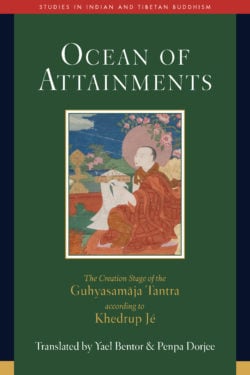
Ocean of Attainments
This commentary on Guhyasamāja tantra is the seminal guide to deity yoga and tantric visualization for the Geluk school of Tibetan Buddhism.
The Guhyasamāja Tantra, called the king of all tantras, is revered in Tibet, especially by the Geluk school. Ocean of Attainments, a commentary on Guhyasamāja practice, was composed by Khedrup Jé Gelek Palsang (1385–1438), a key disciple of the Geluk school founder, Tsongkhapa Losang Drakpa. It explores the creation stage, a quintessential Buddhist tantric meditation that together with the completion stage comprises the path of unexcelled tantra.
In the creation stage, meditators visualize themselves as buddhas at the center of the celestial maṇḍala, surrounded in all directions by male and female buddhas, bodhisattvas, and other enlightened beings. Yet creation-stage practice is not merely visualization but deity yoga—indivisibly uniting the meditation on emptiness with the visualization of the maṇḍala. The creation stage uses the conceptualization in visualization to overcome conceptualization, thereby creating a nonconceptual and nonerroneous direct perception. Such a mind, profound and vast, can bring about a transformation that stops saṃsāric suffering. How can visions generated as mental constructs not be erroneous? To the awakened eye, the buddhas and other beings who dwell in the maṇḍala are “reality,” and in a sense they are more than real.
While the previously published Essence of the Ocean of Attainments is a concise exposition on the practice of the Guhyasamaja sadhana, Ocean of Attainments is far more detailed, providing extensive scriptural citations, clear explanation of the body maṇḍala, arguments on points of contention, reference to other tantric systems, and critiques of misinterpretations. With its extensive and clear introduction, this volume is a vital contribution to the growing body of scholarship on Guhyasamāja and on Buddhist tantra in general.
Learn more about the Studies in Indian and Tibetan Buddhism series.
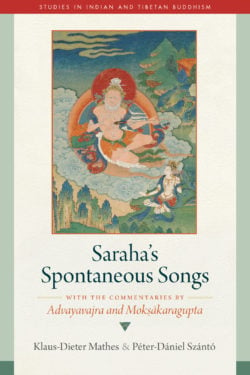
Saraha’s Spontaneous Songs
“Completely abandon thought and no-thought, and abide in the natural way of a small child.” —Saraha
To find liberation and realize the true nature of reality, the Indian Buddhist master Saraha says we must leave behind any conceptual assessment of reality, since no model of it has ever been known to withstand critical analysis. Saraha’s spontaneous songs, or dohās, represent the Buddhist art of expressing the inexpressible. The most important collection of Saraha’s songs is the Dohākoṣa, the Treasury of Spontaneous Songs, better known in Tibet as the Songs for the People, and the Tibetan mahāmudrā tradition, especially within the Kagyü school, has done the most to preserve the lineage of Saraha’s instructions to the present day.
But Saraha was also widely cited in Indian sources starting around the eleventh century, and one Indic commentary, by the Newar scholar Advayavajra, still exists in Sanskrit. In addition, we have independent root texts of Saraha’s songs in the vernacular Apabhraṃśa in which they were recorded. These Indian texts, together with their Tibetan translations, are here presented in masterful new critical editions, along with the Tibetan translation of the commentary no longer extant in Sanskrit by Mokṣākaragupta. Finally, both commentaries are rendered in elegant English, and the authors offer a brisk but comprehensive introduction.
Saraha’s Spontaneous Songs provides the reader with everything needed for a serious study of one of the most important works in the Indian Buddhist canon.
Learn more about the Studies in Indian and Tibetan Buddhism series.
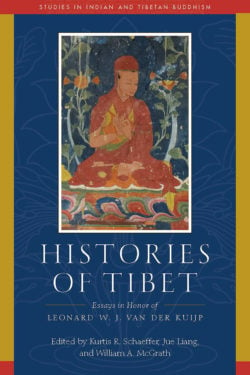
Histories of Tibet
The thirty-four essays in this volume follow the particular interests of Leonard van der Kuijp, whose groundbreaking research in Tibetan intellectual and cultural history imbued his students with an abiding sense of curiosity and discovery.
As part of Leonard van der Kuijp’s research in Tibetan history, he patiently and expertly revealed treasures of the Tibetan intellectual tradition in fourteenth-century Tsang, seventeenth-century Lhasa, or eighteenth-century Amdo. The thirty-four essays in this volume follow the particular interests of the honoree and express the comprehensive research that his international cohort has engaged in alongside his generous tutelage over the course of forty years. His inquisitiveness can be experienced through every one of his writings and can be found as well in these new essays in intellectual, cultural, and institutional history by Christopher Beckwith, Yael Bentor, the late Hubert Decleer, Franz-Karl Ehrhard, Jörg Heimbel and David Jackson, Nathan Hill, Isabelle Henrion-Dourcy, Matthew Kapstein, Todd Lewis, Kurtis Schaeffer, Peter Schwieger, Gray Tuttle, Pieter Verhagen, Michael Witzel, and others.
Learn more about the Studies in Indian and Tibetan Buddhism series.
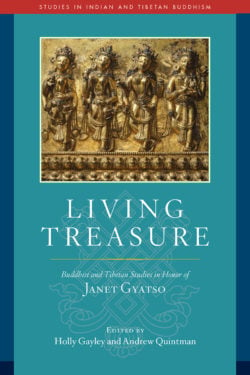
Living Treasure
Senior scholars and former students celebrate the life and work of Janet Gyatso, professor of Buddhist studies at Harvard Divinity School. Inspired by her contributions to life writing, Tibetan medicine, gender studies, and more, these offerings make a rich feast for readers interested in Tibetan and Buddhist studies.
Janet Gyatso has made substantial, influential, and incredibly valuable contributions to the fields of Buddhist and Tibetan studies. Her paradigm-shifting approach is to take a topic, an idea, a text, a term—often one that had long been taken for granted or overlooked—and turn it inside out, to radically reimagine the kinds of questions that might be asked and what the answers might reveal. The twenty-nine essays in this volume, authored by colleagues and former students—many of whom are now also colleagues—represent the breadth of her interests and influence, and the care that she has taken in training the current generation of scholars of Tibet and Buddhism. They are organized into five sections: Women, Gender, and Sexuality; Biography and Autobiography; the Nyingma Imaginaire; Literature, Art, and Poetry; and Early Modernity: Human and Nonhuman Worlds. Contributions include José Cabezón on the incorporation of a Buddhist rock carving in Central Asian culture; Matthew Kapstein on the memoirs of an ambivalent reincarnated lama; Willa Blythe Baker on Jikmé Lingpa’s theory of absence; Andrew Quintman on a found poem expressing worldly sadness on the forced closure of a monastery; and Padma ’tsho on Tibetan women’s advocacy for full female ordination. These and the many other chapters, each fascinating reads in their own right, together offer a glowing tribute to a scholar who indelibly changed the way we think about Buddhism, its history, and its literature.
Learn more about the Studies in Indian and Tibetan Buddhism series.
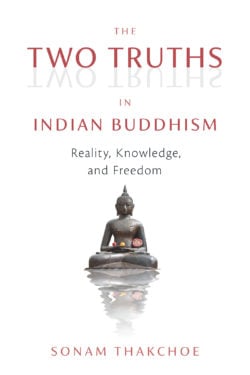
The Two Truths in Indian Buddhism
In this clear and exemplary approach to one of the core philosophical subjects of the Buddhist tradition, Sonam Thakchoe guides readers through the range of Indian Buddhist philosophical schools and how each approaches the two truths: ultimate truth and conventional truth. In this presentation of philosophical systems, the detailed argumentations and analyses of each school’s approach to the two truths are presented to weave together the unique contributions each school brings to supporting and strengthening a Buddhist practitioner’s understanding of reality. The insights of the great scholars of Indian Buddhist history—such as Vasubandhu, Bhāvaviveka, Kamalaśīla, Dharmakīrti, Nāgārjuna, and Candrakīrti—are illuminated in this volume, with profound implications to the practice and views of modern practitioners and scholars.
The Vaibhāṣika, Saūtrāntika, Yogācāra, and Madhyamaka schools provide a framework for a continuum of philosophical debate that is far more interrelated, and internally complex, than one may presume. Yet we see how the schools build upon the findings of one another, leading from a belief in the realism of external phenomena to the relinquishment of any commitment to realism of either external or internal realities. This fascinating movement through philosophical approaches leads us to see how the conventional and ultimate—dependent arising and emptiness—are twin aspects of a single reality.
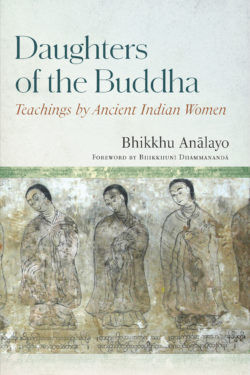
Daughters of the Buddha
A testimony to the invaluable contributions made by the women who were direct disciples of the Buddha—and a source of inspiration to Buddhist women today.
It’s a common perception that the earliest textual records don’t contain many, if any, teachings by the Buddha’s female disciples; yet, this is not the case. In fact, the earliest discourses record a range of teachings from Buddhist women, lay and monastic. Unfortunately their important contributions have so far not received the attention they deserve.
In Daughters of the Buddha, esteemed scholar-monk Bhikkhu Anālayo examines the accounts of the first female disciples in the canonical scripture, taking the reader back to the earliest period in the history of Buddhism that can still be accessed today. He dedicates each of the twenty-one chapters in the volume to an individual and remarkable woman, sharing her particular insights and teachings with the reader. Both nuns and laywomen are featured in these pages, and their diversity of voices and richness of thought will serve as instruction and encouragement for modern scholars and practitioners alike.
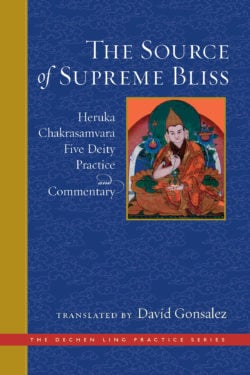
The Source of Supreme Bliss
The Source of Supreme Bliss contains the first English translations of important commentaries on the Highest Yoga Tantra system of the Heruka Chakrasamvara five deity practice.
Included is a lucid, practical, and deeply profound explanation of the generation stage by Ngulchu Dharmabhadra. This is followed by an extremely rare and profound commentary by the First Panchen Lama Losang Chökyi Gyaltsen on the completion stage, along with a commentary on how to perform a proper Chakrasamvara retreat. The second half of the book comprises translations of the ritual texts associated with the commentaries.
Indispensable for anyone who undertakes this practice, The Source of Supreme Bliss will also provide rich and profound insights for those interested in Highest Yoga Tantra.
The Dechen Ling Practice Series from Wisdom Publications is committed to furthering the vision of David Gonsalez (Venerable Losang Tsering) and the Dechen Ling Press of bringing the sacred literature of Tibet to the West by making available many never-before-translated texts.